Anatomy of a 5-Hour-a-Week Card Flipping Business
How I flip sports cards on about 5 hours a week, with 5 kids and a life to run
By Cameron Smith
2026 Edition
Download as a PDF|Send to Kindle (EPUB)For Kindle, download the file, then drop it into amazon.com/sendtokindle.
Contents
- Introduction
- 01Chapter 1: Why I Flip Cards (And You Should Too)
- 02Chapter 2: Business DNA: Why 5 Hours Is the Point
- 03Chapter 3: Ice & Water: My Actual Week
- 04Chapter 4: Narrow Your Focus With Ruthless Efficiency
- 05Chapter 5: Cards That Move: Liquidity and Value
- 06Chapter 6: Timing: Buy Quiet, Sell Loud
- 07Chapter 7: Grading: The Value Lever You Control
- 08Chapter 8: Selling With Little Effort
- 09Chapter 9: The Scoreboard: What a Typical PSA Order Looks Like
- 10Chapter 10: Starting in a Realistic Way
"If you're following the crowd, you're probably doing it wrong."
- Me, in roughly half of my newsletters

Introduction
Welcome!
What you are about to read is a case study of my sports card flipping business, which I've been running out of my house since 2020.
Things didn't click immediately, but I eventually built sports cards into a business that creates consistent monthly income even though I:
- Have 5 kids
- Run a marketing agency with my wife
- Cook dinner every night
- Work on my 210,000-word door-stopper of a fantasy novel daily
- Have 3 other books published on Amazon
- Write two newsletters per week and handle all the marketing, product building, and subscriber management that goes with it
- Turn off my computer at 4 p.m. every day
My workload on sports cards?
About 5 hours per week.
If I were to describe what my card flipping business looks like, I'd tell you a story:
One night I was lying in bed reading to my son. We were just starting out when my smartwatch buzzed. An auction I'd been watching had 9 minutes left.
So I did what any responsible dad would do and secretly opened up my phone...
I set it on the blanket next to me, with the countdown ticking away while I finished whatever Nibbles book we were reading. I typed in what I was willing to pay, then tapped "enter" when the timer hit 10 seconds. I won the card, and my son barely knew I had even done it.
That moment is pretty much my whole business. I already knew what the card was worth and exactly what I was willing to pay, so the actual "work" took about 10 seconds.
And before you ask: no, I'm not in the business of short-changing my children in order to be on my phone. The real point is that I can have a profitable card flipping side hustle and still have a life.
This case study is for people who are new to card flipping, or have tried it and struggled, and want a business that fits around their life, not the other way around.
I've been doing this for about five years now, with thousands of transactions on eBay along the way. I write a sports card newsletter that's had over 12,000 people subscribe, and I wrote Cards to Cash, which has 100+ reviews on Amazon and a 4.8-star average.
And it works for other people too:
"Started listing some cards on eBay last weekend and I sold the P. Crow-Armstrong for a profit of $422.63 for my first sale."
Steve E.
"Instead of purchasing a $25 Dylan Harper rookie card insert, I purchased a Dylan Harper case hit based on Cameron's training, and was able to flip it raw for 50% profit!"
Melanie M.
What This Actually Looks Like
In a normal month, I make $1K to $2K profit in about 5 hours per week. That number goes up and down, based on PSA's turnaround times and seasonality. (In Chapter 9, I'll show you what a typical PSA order looks like.)
"Wait, That's It?"
I know what you're probably thinking: "But I follow guys who make $10K+ per month on IG and YouTube."
I've tried the high-volume version.
There was a stretch where I worked 4-6 hours per day on cards because I was unemployed and needed more cash.
I hated it, and I made much less per hour. So I cut back on purpose as soon as I could.
Maybe those guys on YouTube do make $10K. I'd just want to know how many hours it takes.
Who This Is For
I wrote this for two kinds of people:
- You're brand new. You've never flipped before, or you're new to sports cards altogether. You've heard people make real money doing this, and the idea of making money with your sports knowledge jazzes you up. ("I'm sorry, did you say jazzed?" Name that movie.)
- You've tried it, and it hasn't worked. You bought some cards, maybe got lucky once or twice, and now you're sitting on a stack of cards worth less than you paid. (Been there. I'll show you my worst ones later.)
Now, who is this not for?
If you're already crushing it, what do you need me for? There are plenty of guys online who'll tell you to list 300 cards a week, sell on six different platforms, and stay logged on until midnight.
If that sounds fun, this case study isn't for you.
What You'll Learn
- What my actual week looks like, down to the minutes
- My Monday hour, the one session that does most of the work
- How to buy the right cards, at the right time, at the right price
- How I frequently sell cards in 1-2 days
- Why cheap cards are riskier than expensive ones (yes, really)
- How I use grading to turn small flips into big ones
- How to get started with $500
A Quick Note Before We Start
I'm going to walk you through exactly how I built this, so you can build your own version.
I'll share with you plenty of examples, but those aren't current recommendations because the market moves fast.
If you want to know the best current strategies, that's what my free newsletter is for every Thursday. (If you were forwarded this case study, you can subscribe here to get it each week.)
Or, if you want to see exactly what I'm buying each week with my price targets, that's the premium newsletter, HCL Investor, that sends on Saturdays.
One last thing. There's nothing special about me. I don't have secret connections in the sports card world or a fancy finance background. I don't have deals with Fanatics or Panini to get special pricing.
I've probably just been at this longer and made more mistakes than you.
Case in point: I paid the most ever for a 1997-98 Tim Duncan Topps Finest PSA 9 rookie. It cost me $150, and a year later it was worth about $15. I'll show you the chart later, because it still makes me laugh.
Let's get into it.
How I Make Money
Before we get into the details, here's the big picture. I make money flipping cards in two main ways, plus a third one that's more occasional.
1. Short-Term Flips
I buy a card I think is primed to rise in value, hold it for 3-6 months, and sell it for a profit. No grading. Just reading the market, predicting player breakouts, and understanding price trends.
Sometimes, this happens much faster:
For example, I bought a Wemby PSA 10 Prizm rookie for $274. I sold it 2 weeks later for $400.
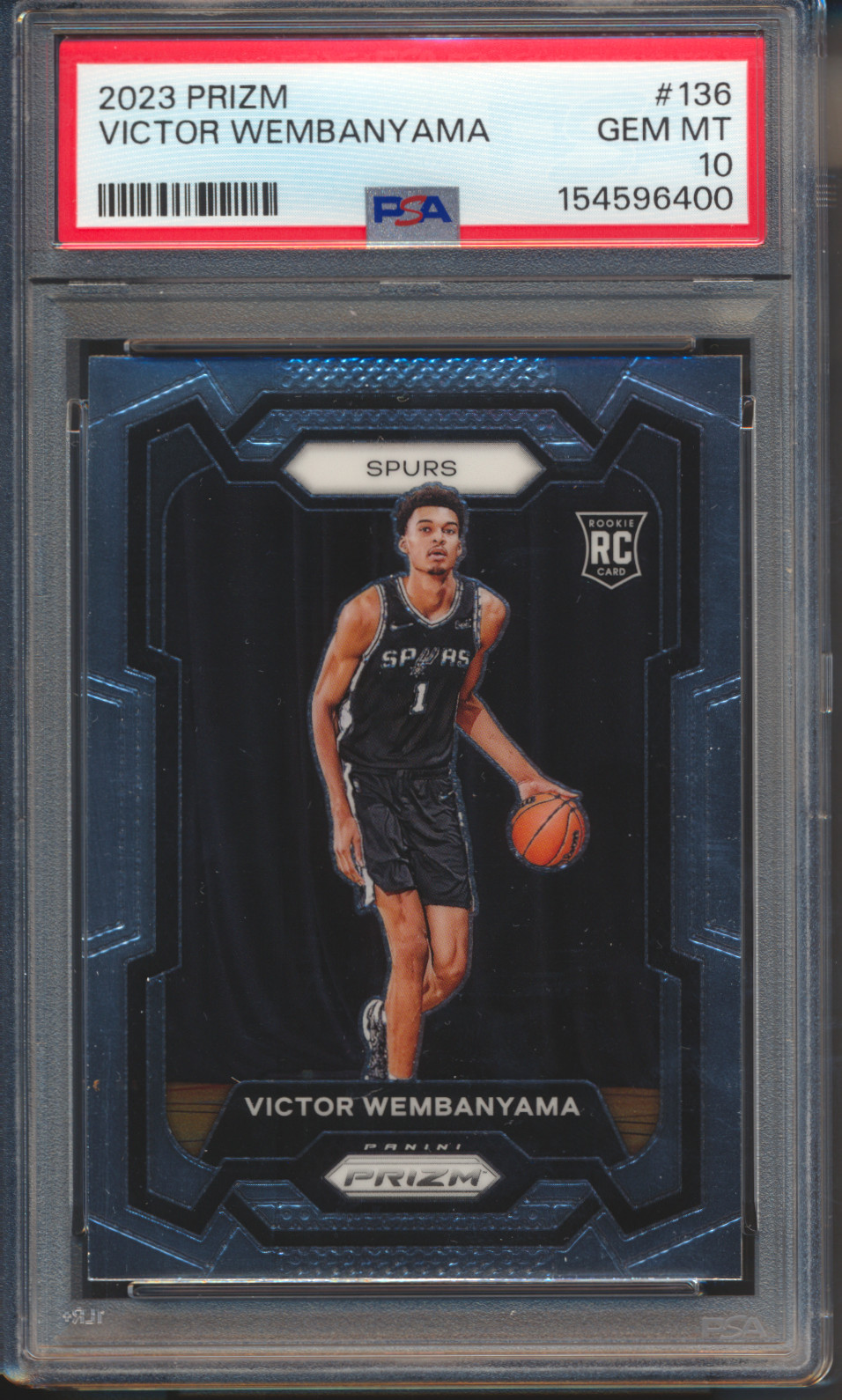
Victor Wembanyama Prizm PSA 10 rookie
- Bought
- $274
- Sold
- $400
- Profit
- $74
2. Grading
This is where most of my bigger wins come from. I buy raw cards that I'm confident will come back a PSA 10, send them in, and sell the slabs.
For example, I bought a raw Dylan Harper Sapphire Selections card for about $115. It came back a PSA 10, and I sold it for $684. After grading and fees, I made about $437.
Grading takes a little more work up front, and you have to wait on PSA. But once you know what to look for, it's one of the more predictable ways to make money in the hobby.
3. Long-Term Holds (Every Once in a While)
Sometimes I stumble into a long-term hold. Other times I see something compelling and buy it on purpose.
For example, I bought a sealed hobby box for about $1,600 because I thought the NBA rookie class that year was fantastic. That box went straight into the closet, and it's going to sit there for a long time.
Most of the profit from my flips and grading goes right back into the next flip. The rest goes to my family (like Christmas or vacations), my own collection, and the occasional long-term hold like this one.
Chapter 1
Why I Flip Cards (And You Should Too)
When I was a kid, I collected cards the way most kids did. I bought packs, sorted them into binders, and traded with my friends. It never once crossed my mind that you could actually make money doing this.
I stopped collecting at 14 because I got tired of having no money for burgers or movies. I put all 6,000 of my cards into one of those giant purple plastic tubs.
A few decades later, I was listening to a Bill Simmons podcast with Mike Gioseffi from Sports Cards Nonsense. They were talking about how crazy the card market had become. Everyone was stuck at home during COVID, so people were digging out their old collections. Some of them were making real money flipping cards.
I remembered that tub of cards and had my parents fish it out of the attic.
I spent a few glorious weeks going through every single card. I sold 30-40 on eBay, sent 12 off to get graded, and got completely hooked again.
But at first, I was pretty terrible at flipping. More on that later in Chapter 6.
But slowly, over time, I learned enough of what not to do, and began building frameworks that resulted in wins.
Now, I have money every month to help pay for my PC, help cover bills when needed, or pay for extra family fun.
The Hobby Is Bigger Than You Think
A lot of people still picture sports cards as a kid's hobby. A few packs at the grocery store, a binder under the bed. It's funny seeing the look in people's eyes when I tell them that I flip sports cards and teach others how to do it, too.
What many don't realize is that it's consistently growing and becoming more legitimate. Famous investors (like Kevin O'Leary) and plenty of celebrities are dropping millions of dollars on cards, making front-page news.
If you're worried about missing the boom, you're not too late.
Here's why:
eBay reports there were 42 million sports card transactions totaling $1.78 billion in 2025 alone!
CardLadder, the card pricing tool I use, tracks sales from 5 large platforms (including eBay). Here's the month-over-month chart for card sales:
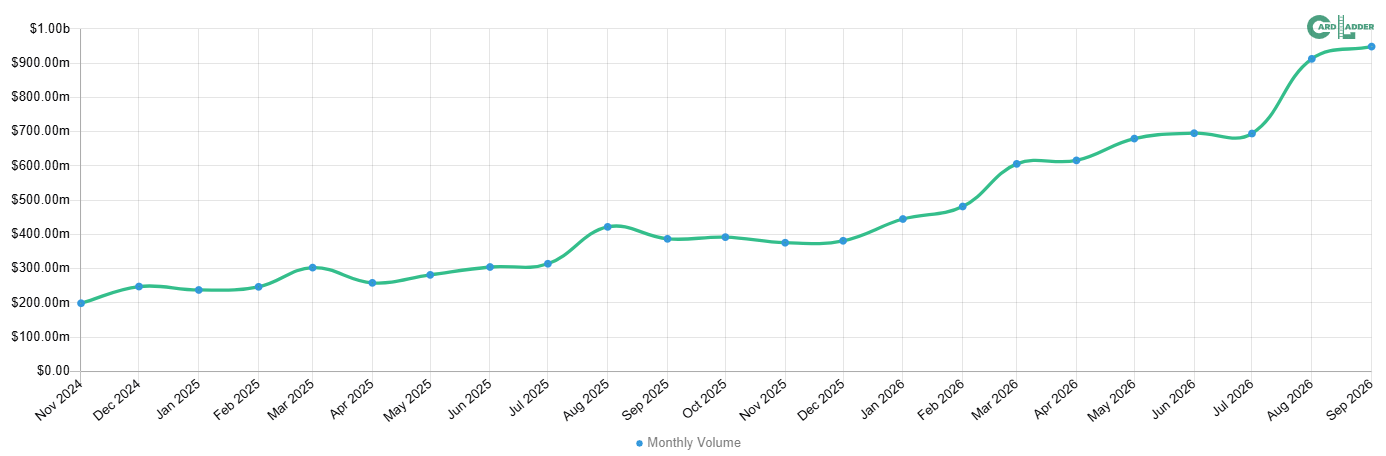
And you can look up a dozen market predictions from big-time financial sites that project sports cards to continue growing at an amazing rate.
What My Successful Flips Look Like
When most people think about making money with cards, they picture the home run. Somebody pulls a rare card out of a pack and sells it for $5,000,000. That's what the headlines show, anyway.
That's not how I make money. I typically go after singles and doubles, with the occasional home run mixed in. Here's what that looks like with real flips:
- A single: I bought a raw Dylan Harper auto for $117 and sold it 18 days later. After fees, I made $33, about a 28% return.
- A double: I bought a Dylan Harper Rock Stars card for $145, sent it to PSA, and it came back a 10. It sold for $558, and I made about $354 after grading and fees. (That might be more of a triple...)
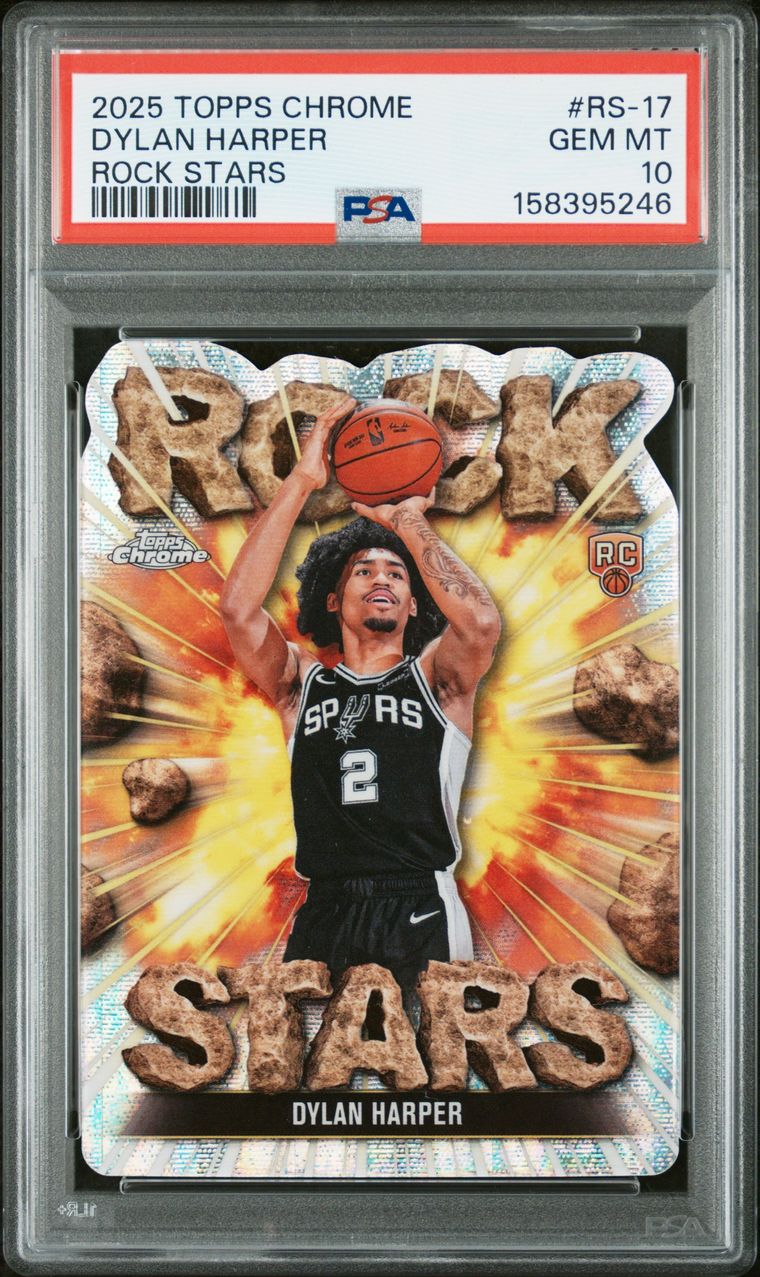
Dylan Harper Rock Stars PSA 10
- Bought
- $145
- Sold
- $558
- Profit
- $354
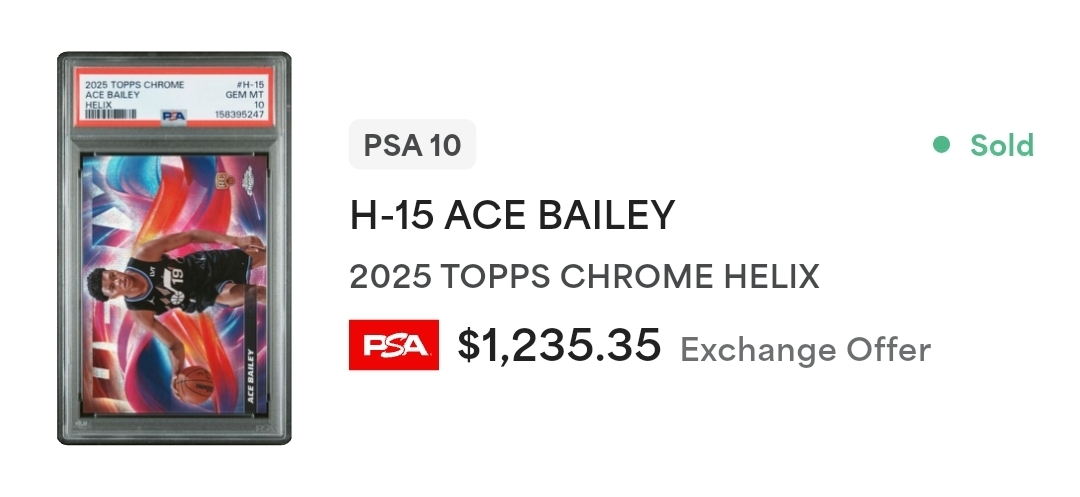
- A home run: I bought an Ace Bailey Topps Chrome Helix for $359, and it came back a PSA 10. It sold for $1,235, and I walked away with $790 profit.
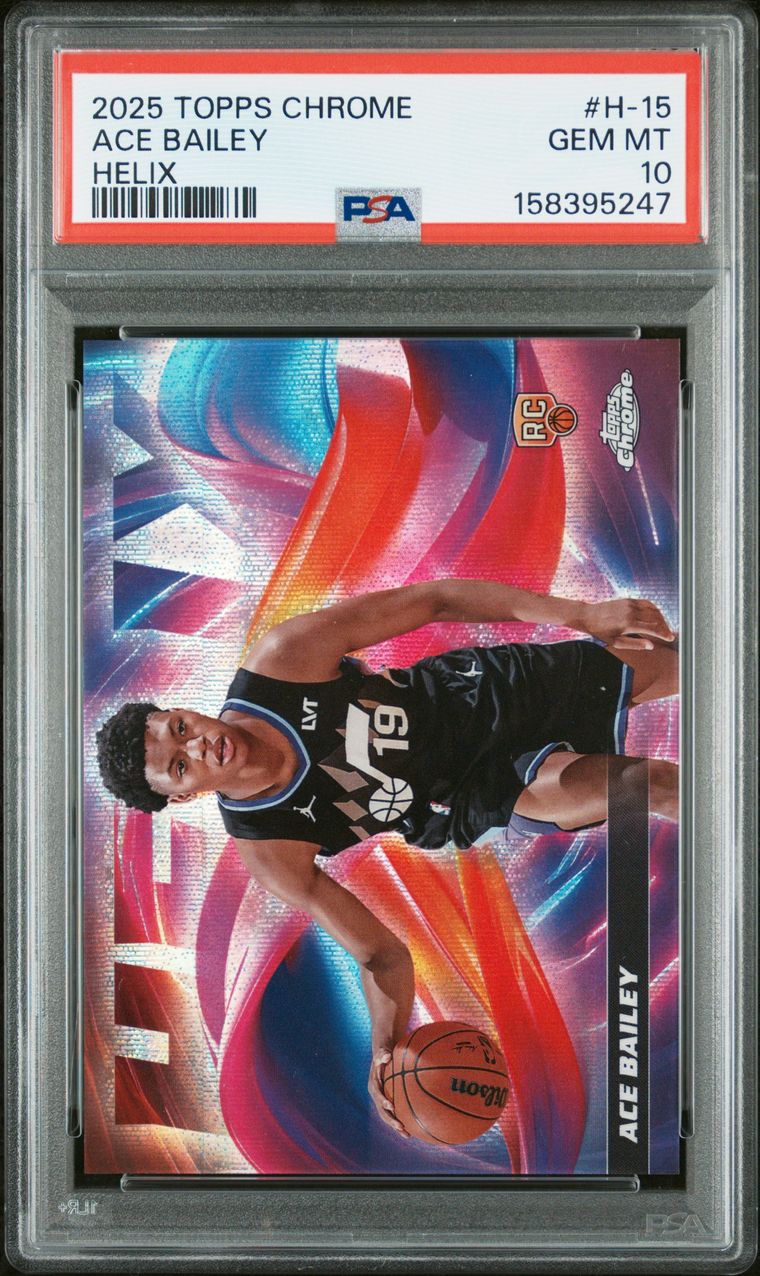
Ace Bailey Topps Chrome Helix PSA 10
- Bought
- $359
- Sold
- $1,235
- Profit
- $790
Most of my flips are singles and doubles. They're not exciting, but they're steady and predictable.
Raw flips usually net me around 30%. Grading wins can return a lot more, which is why they make up the majority of my home runs.
In a typical month, I get a few doubles, a pile of singles, and every so often a home run. That adds up to about $1K to $2K profit per month without being glued to my phone.
The #1 Mistake With Card Flipping
I'd be lying if I told you everyone makes money with cards. Plenty of people lose money.
The #1 problem I see from the people I teach is this:
They buy what everyone else is buying without any research or plan.
I call that Buy & Pray. You buy a player who's on a hot streak, or one you heard about from an influencer. You jump in and you hope it keeps going up.
The problem? You're buying someone at the same time everyone else is, after he's already increased in value.
You bought on emotion rather than logic, with no clear reason why that player should continue to rise.
The opposite of Buy & Pray is Stack & Sell. I'll break that down in Chapter 2.
Chapter 1 in a nutshell
- The sports card market is big, busy, and still growing, which means it's easier than ever to buy and sell cards.
- Flipping can pay for your hobby and then some.
- I make most of my money on steady singles and doubles, with some home runs mixed in.
- The #1 mistake is Buy & Pray: chasing what everyone else is buying with no research or plan.
Chapter 2
Business DNA: Why 5 Hours Is the Point
Most people in the card world think there's one way to build a flipping business: do more. More cards, more listings, more platforms, more hours.
For most, that's a mistake.
I go the other direction. Five hours a week is the whole design of my business. Every rule I follow, every card I pick, and every tool I use is there to make that number work.
Before I show you exactly what I do, I'll pull back the curtain a bit on my why.
My Sweet Spot (and Why I Stop There)
For me, the sweet spot is $1K to $2K per month with about 5 hours of work per week.
I mentioned in the intro that I tried the 4 to 6 hour days. I hated how my head was always swimming with data and auction end times, and I was frustrated that the extra hours only led to marginally more income.
There's one more reason I keep flipping at this size, and it's the one I'm most grateful for.
A while back, the marketing agency I run with my wife lost its two main clients. If you've ever had a big chunk of your income disappear, you know that sinking feeling.
For a while, my card flipping profit helped pay the bills.
This little side hustle was a cushion for my family when things got tight. Yes, it was a bummer that for a while I had to put profit into my mortgage instead of back into sports cards, but I was grateful for the cash flow.
If my sports card business required 20 hours per week, there's a 0% chance I would have been able to maintain it alongside the rest of my life.
But I could grow a 5-hour per week business into something real.
The Grind Is the Enemy
A while back, someone posted in a Facebook group an impressive stack of sealed boxes with the caption that read something like:
"About to rip all these boxes that I bought from my flipping profits."
So naturally, there were hundreds of comments...
"How do you do that?!"
"I'm jealous, that's amazing!"
It seems like he's crushing it, right?
But later in the comments, he shared the actual numbers behind what he'd done:
He made $11,000 profit over a 3-month period... but he'd done 10,000 transactions to get there!
(That's pretty much Bulk Bill to a T... you'll meet him in a minute.)
Turns out, he was selling base cards for $0.50-$2 each, and did over 100 transactions per day.
Think about what every one of those sales takes: finding the card, taking photos, writing the listing, packing it up, printing a label, and getting it to the post office. Ten thousand times.
That's the grind... and the card world is full of it. Guys who:
- Buy entire collections and spend dozens of hours sorting through junk to find a few gems
- Buy up hundreds of singles on various platforms and sell them live
- Log into eBay 50 times a day hoping to get lucky with underpriced listings
- Jump from platform to platform to platform hoping to stumble across deals
And sure, maybe they're profitable (plenty aren't), but at what cost?
That guy with the 10,000 transactions claimed he loved the grind, and that's great for him.
Me? I'd rather make money in 1/10th the time and go to the park with my kids. I'm positive my hourly income from sports cards dwarfs his.
Why You Should Do Less Even if You Have the Time
When I was starting out, I think that more free time would have made me worse at card flipping.
Sounds backwards, I know.
But I've seen this myself and with others I've worked with:
If you have more time, you often spend it wandering aimlessly in the wilderness. All that extra time doesn't force you to be efficient.
It's like when you give a chore to your 5-year-old and tell them they have 8 hours to finish it. Trust me, they'll spend 7.9 hours digging in the mud, and the last few minutes complaining that they don't have time to finish.
And even if you do have more than 5 hours per week, I would highly recommend you still learn the discipline to be ruthlessly efficient. Don't be the guy that wanders the internet, aimlessly buying cards because an influencer said so or because you "like the player."
Meet the Cast
Over the years, I've noticed the same few characters show up in this hobby again and again. You might even be one of them right now (no judgment, I've had my moments).
Or if you're brand new, my goal is to stop you dead in your tracks before you become any one of these:
Dungeon Dave disappears into his basement every night after dinner and comes back up three hours later. He's checking prices, scrolling listings, refreshing auctions, and watching break streams. His family has stopped asking what he's doing down there. Dave might make some money, but the real cost is having no life.
Platform Pete is everywhere. He buys and sells on eBay, Whatnot, Instagram, and Facebook Marketplace, and he spends three weekends a month at card shows. His phone is cluttered with apps. He's so busy being everywhere that he never gets great at anything.
Bulk Bill has an eBay store with 1,000 listings, and his average sale is less than $5. His spare bedroom is a wall of cardboard boxes. He spends his nights stuffing cheap cards into envelopes and his Saturdays in line at the post office. On paper, Bill looks like a big-time seller. In real life, his card hustle is a second job for less than minimum wage.
Rip-It Rick buys boxes and joins every break in sight. He's chasing the one big hit that'll pay for all of them, and every so often he gets just close enough to keep going. Rick calls it investing. I call it a slot machine with a group chat.
I'm not knocking these guys as people. I was definitely a Rip-It Rick when I got back into this (my son still is), and I dipped my toes into being a Bulk Bill.
Some of them really love what they do, and good for them. Some are profitable, but none of them fit inside a 5-hour week.
That's not what I'm going to teach you.
Buy & Pray vs. Stack & Sell
Stack & Sell flippers work with cold logic. They stack multiple reasons before buying and selling cards.
Here's how the two look side by side:
| Buy & Pray | Stack & Sell | |
|---|---|---|
| Why he buys | It's trending and everyone's talking about it | Two or three real reasons the price should rise |
| When he buys | Right after the big news | When few are talking about the player |
| What he checks | Highlights and social media | The price chart, the timing, and recent sold prices |
| Exit plan | "I'll know when it's time" | A sell price, decided before he buys |
| Time it takes | Hours of watching and worrying | One decision, then back to life |
| What usually happens | Buys near the top and holds it on the way down | Sells into the hype he saw coming |
A major problem with Buy & Pray (besides losing stacks of cash) is that it eats your time.
When you don't have an exit plan, you have to watch everything like a hawk. You check the price every morning. You follow the news. You check the box score every day, hoping the player had a great game. That's a lot of hours for a card you bought in thirty seconds.
Stack & Sell flips that around. All the thinking happens up front, in one focused session. Once a card is bought and listed at my exit price, I don't have to babysit it. The decision's already made.
What does stacking two or three reasons look like?
Think about Chet Holmgren for a second.
- Young player
- Superstar potential
- Great team with potential to win championships
- Had a bad 2026 playoffs against Wemby, and then was injured to start the next season
Stack all those up, and there's a pretty compelling case his prices could rise.
Now, there are dozens of reasons that players can rise, and the more of these you stack up, the more the odds tilt in your favor.
(I'll show you how I find those reasons in Chapter 5.)
What Scaling Looks Like for Me
So what happens when I want to make more?
Most people's answer is to do more... but that's how you turn into Dungeon Dave.
My answer is bigger cards.
Until recently, a lot of my buys landed in the $50 to $400 range. Lately, I've been purchasing more in the $500 to $800 card range (those cards get me an eyebrow raise from the wife). The work barely changes. It's still one Monday hour, still a handful of cards a month, still one platform.
Those more expensive cards still need time to pan out (either to naturally go up in value or return from PSA), but my plan is to up my income to $2,000 to $3,000 per month with no extra work.
(I still take flyers on cheaper cards, but that's more for fun or to test a theory I have. I don't consider those cards as part of my core investment strategy.)
Flipping is a side business built around a life, never a second job.
Chapter 2 in a nutshell
- The grind is the enemy. More listings and more hours don't add up to more profit (10,000 sales for $11,000).
- Watch out for the four characters: Dungeon Dave, Platform Pete, Bulk Bill, and Rip-It Rick.
- My sweet spot (at the moment) is $1K to $2K a month. It's big enough to matter, small enough to fit around my family, and it's been a real cushion when life got hard.
- Stack & Sell saves you money and time, because all the thinking happens before you buy.
- To scale, buy bigger cards. Don't add hours.
Chapter 3
Ice & Water: My Actual Week
Whenever I tell people I flip cards in about 5 hours a week, I get the same reaction. It's somewhere between "no way" and "okay, what are you leaving out?"
So in this chapter, I'm leaving nothing out. Here's exactly how my week works, down to the minute.
The Cup of Ice
Picture a cup packed full of ice. The cup is the time that you have in a week: 168 hours.
The ice cubes are the activities in my life that take up time. My kids. Cooking dinner every night. Writing my newsletters. Running the agency with my wife. Watching games (that one's non-negotiable).
With card flipping, there's just one ice cube in the cup, representing about 60 to 90 minutes per week:
My Monday Hour.
Of course, you can still pour water into that cup full of ice. The water is all the other quick tasks during the week that fit in the gaps.
The majority of my card flipping business is run as "water" activities a few minutes at a time.
If any activity I'm considering for my business requires another ice cube, I don't do it.
A card show that eats a whole Saturday? Doesn't fit. Sorting a 5,000-card collection I bought online? Doesn't fit. Listing 100 cards a night? Definitely doesn't fit.
That one rule cuts out about 90% of what other flippers spend their time on. (We'll go through everything I cut in Chapter 4.)
The Monday Hour
Think of the Monday hour like meal prep.
If I chop the onions, marinate the meat, and plan the week's dinners on Sunday, every weeknight is easy. If I skip it, I'm frantically piecing together whatever I find in the fridge at 5:30 with hangry kids asking every 5 seconds "What's for dinner?!"
(Cue all the parents nodding along...)
Cards work the same way. All the hard thinking happens in one focused hour, so the rest of the week is just quick reactions.
Here's how that hour breaks down:
- Pick Player Targets (10 minutes). I brainstorm players that have a real reason to rise over the next 3-6 months. I’ll think about what sports are good to go after right now, pull up a list of teams, and start writing down names to go after. I'll generally have 10-15 names.
- Research Prices & Gem Rate (15 minutes). I'll look at CardLadder charts for my top targets to see whose prices are down. I'll also use gemrate.com to see if any of those players have cards worth going after. I'll pull PSA 10, PSA 9, and raw comps and plug them into the Should I Grade This Calculator. (More on this in Chapter 7.)
- Set Saved Searches (5 minutes). I only do this for my top few targets. 30 pings a day is just too disruptive.
- Search eBay & Place Bids or Offers (30 minutes). I'm looking at what's for sale, comping cards, looking at images to assess condition, sending messages for better pictures, and bidding or placing offers on cards I'm good with.
This varies from week to week, as sometimes I'll only spend 20 minutes if I stumble across several great targets quickly.
The Water
For the rest of the week, my buying and selling activities happen in chunks of 5 minutes or less that fit in the gaps, like the water filling in around the ice.
This can look like:
- A seller responds with better pictures of the card. I take a quick look while food's in the oven and decide if it's worth a bid or an offer.
- A saved search pings me while I'm working on a client's email sequence. I pause, take a look, and either send an offer or click out.
- A buyer sends me a lowball offer while I'm on the couch at 9:30 at night. I counteroffer, then set my phone back down.
- An auction is ending during one of my kids' soccer games. I pull out my phone and glance down at the timer every minute or so, and place my bid at the last second. I either win or don't, and I've learned not to stress.
None of these take more than a few minutes. And none of them need much thought, because the thinking already happened on Monday.
Remember the story I shared about winning an auction while reading to my kid?
That card didn't come out of nowhere. It had been on my target list for weeks. I'd already looked at the comps, checked the photos, and decided exactly what I was willing to pay. I'd bid on it earlier in the week. When my watch buzzed, there was nothing left to figure out.
So all I had to do was set my phone on the blanket, keep reading, and type in my number at the end. 10 seconds of work, made possible by prepping earlier in the week.
That's the whole trick. The water only works because the ice cube did its job first.
A Sample Week
Here's what a typical week looks like when you add it all up. Every week is unique, but this wouldn't be out of the ordinary for me:
| Day | What I do | Minutes |
|---|---|---|
| Monday | The Monday hour: research, target list, saved searches, photo requests, offers and bids | 60 to 90 |
| Monday night | Reply to sellers and counteroffers from the couch | 15 |
| Tuesday | Mail day: inspect, decide on grading, list | 10 to 20 |
| Tuesday night | Accept offers, answer buyer questions | 15 |
| Wednesday | Saved search pings, place bid or two, compare my listings to recent sales | 10 |
| Wednesday night | Pack the cards that sold | 15 |
| Thursday | Mail day: inspect, decide on grading, list | 20 |
| Thursday night | Replies and offers | 15 |
| Friday | A few bids and offers between everything else | 15 |
| Friday night | Pack the cards that sold | 15 |
| Saturday (optional) | Optional catch-up, 1-2 times a month: prepping a PSA order, listing cards, other stuff I missed | 0 to 60 |
| Sunday | Nothing. Family day. | 0 |
| Total | 3-5 hours |
Notice that only the Monday hour is a real block of time. Saturday is an optional catch-up that only happens once or twice a month.
Everything else is a few minutes here and there, tucked around dinner, games, and bedtime.
Managing the Itch
The hardest part of the 5-hour week has nothing to do with time.
It's the itch.
It happens when you haven't bought anything in a week or two, and nothing seems to be available on your target list.
You feel like you're "falling behind," so you hop on eBay looking for something to buy.
That itch is where most bad buys come from. I've certainly done this.
So here's how I think about it now:
A week where I don't buy anything still counts as a decent week, because I didn't lose any money. Skipping a card that doesn't fit my rules is avoiding a loss.
Plus, things are still happening in my business. I have cards at PSA and cards listed on eBay. It's not like everything has ground to a halt.
And if I see something I like during the week, I put it on next Monday's list instead of buying now. This keeps me from impulse buys.
Chapter 3 in a nutshell
- Think of your week as a cup of ice water. Life's big things are the ice. Flipping gets one cube: the Monday hour.
- Everything else about flipping is water that fits in the cracks. If it can't fit in the water, don't do it.
- The Monday hour does the hard thinking: research, a 10-15 card target list, saved searches on your best targets, photo requests, offers, and bids.
- Mail day takes 15 to 20 minutes: inspect, decide on grading, and list right away at the price you already picked.
- The whole week adds up to about 5 hours.
- Not buying is fine. Skipping a card that doesn't fit your rules is avoiding a loss.
Chapter 4
Narrow Your Focus With Ruthless Efficiency
The last chapter showed you what I do with my 5 hours. This chapter is about what I don't do, which might be just as important.
The more experienced I get with flipping cards, the more activities I cut. That's the beauty of a 5-hour week. I don't have to go searching for ways to fill my time.
What's left is one platform, 3 sports (at most), a handful of tools, and a short list of things I flat-out refuse to do.
That's why my tagline is: fewer cards, one platform, 5 hours a week.
One Platform: eBay
I buy on eBay. I sell on eBay. That's it.
No Whatnot, no Instagram, no Facebook groups, no card shows. I get asked about this all the time.
But here's why eBay gets my time:
- It has the most buyers. When I list a good card at a fair price, someone is usually ready to buy it. I don't have to go find a buyer, because the buyers are already there.
- Built-in alerts. My watch buzzes with new cards listed, and I can go check them out. No logging in 10 times a day to see if there's something new.
- The comps live right there. I can see what specific cards have sold for without leaving the app. (Most of the pricing tools I use pull from eBay sales anyway.)
- One app. I'm not checking five apps or remembering which buyer messaged me where. Ain't got time for that.
- No hauling boxes anywhere. My "storefront" is my phone. It's open 24/7, and I never have to load up the car.
Could I squeeze out a few extra dollars by selling on other platforms? Probably. But every new platform means more apps, more messages, more fees to track, and more time. For me, that trade isn't worth it.
The tradeoff is eBay's fees, but other platforms either have fees themselves, or buyers and sellers bake those in. Facebook buyers often pay 85% to 90% of comps because they know the seller is saving by not selling on eBay.
3 Sports, At Most
Basketball is my main lane. Football is a solid second. Baseball comes in a distant third, because it's my weakest of the 3.
But why not chase soccer and hockey and F1 and Star Wars and Marvel and Pokemon and everything else?
Because you can only really follow so much at a time.
Remember, every buy needs 2-3 real reasons behind it. To find those reasons, you have to know a sport well. You need to know who's getting more minutes, who's about to come back from an injury, and which rookie the hobby is sleeping on. You need to know what normal prices look like, so you can spot a deal when one pops up.
I can do that for basketball because I watch it all the time anyway. Trying to keep that same level of knowledge across four or five sports is impossible.
And too many sports leads to the very scientific "cat chasing laser pointer" syndrome.
"I just heard a seller on Whatnot hyping up F1 and telling everyone to go buy this dude... maybe that will work!"
But the reality is, you can make as much money as you need to from a single sport. Honestly, maybe even a single player if it's a superstar. Having a few sports can help smooth your income during one sport's offseason, but going after everything spreads you too thin.
What I Refuse to Do
This is my "no" list. Plenty of people make money doing these things. But none of them fit in the water between the ice, so I don't do them:
- Card shows. A show eats a whole Saturday, plus the drive, plus the time to pack and unpack. That's a full week of my flipping time gone in one day.
- Visiting local card shops. My closest one is 30 minutes away, and they rarely sell singles at good prices.
- Buying whole collections to sort. I did something similar with my own 6,000-card tub. It was fun... once. Sorting thousands of cards to find a handful of good ones is a lot of hours with rarely a return that justifies it.
- Running an eBay store full of cheap cards. More listings means more photos, more questions, more packing, and more trips to the post office. I'd rather sell a few good cards than hundreds of cheap ones. I used to do this and I swore it off.
- Breaks and ripping boxes for profit. It's fun, but it's gambling. I wasted thousands of dollars to get back a fraction in profit.
Saying no to all of this is what makes the 5-hour week possible.
Every "no" is an hour I get to spend somewhere else.
My Small Tool Stack
You don't need a dozen subscriptions to do this well. Here are the websites and subscriptions I use:
| Tool | Cost | What I use it for |
|---|---|---|
| CardLadder | $20/month | Price history charts and sales data. This is where I figure out why a card moved and where it might be headed. |
| 130point | Free | Pulls in eBay's sold prices, including what Best Offer listings actually sold for. Great for a fast comp check. |
| GemRate | Free | Checking how often a card comes back a PSA 10 before I decide to grade it. |
| eBay saved searches | Free | Alerts on my top targets, so the deals come to me. |
That's the whole list. If you're just starting out, you can get pretty far with only the free ones: 130point, GemRate, and eBay saved searches. Add CardLadder once you're ready to get serious about reading price charts. (We'll get into that in Chapter 6.)
Platform Pete, Bulk Bill, and Me
Remember Pete and Bill from Chapter 2? Here's what a week looks like for each of us.
| Platform Pete | Bulk Bill | Me | |
|---|---|---|---|
| Where he sells | eBay, Whatnot, Instagram, Facebook, card shows | His eBay store | eBay |
| Cards listed | Dozens, spread across every app | Hundreds or thousands | A handful |
| Average sale | All over the place | Less than $5 | $50 to $400+ |
| Shipping | Constantly, from four different apps | Many per day | A few cards a week |
| Weekends | At card shows three Saturdays a month | In line at the post office | Hanging with family |
| Inboxes to check | Five | One, and it's overflowing | One |
| Hours a week | 30+ | 50+ | About 5 |
Pete and Bill are both working hard. Some weeks they probably sell more than I do. But they've built second jobs for themselves, and I've built a side hustle that fits around my life.
Chapter 4 in a nutshell
- Fewer cards, one platform, 5 hours a week.
- I buy and sell only on eBay. It has the most buyers and makes comping easy.
- Go deep on 1-3 sports. Real income can come from one narrow lane.
- Say no to anything that can't fit in the water: card shows, sorting whole collections, cheap-card stores, breaks, and extra platforms.
- A small tool stack is plenty. You can start with just the free tools.
Chapter 5
Cards That Move: Liquidity and Value
If you only have 5 hours a week, you can't afford to buy cards that sit.
A card that takes a year to sell ties up your money, takes up space in your head, and keeps you checking your listings. A card that sells in a few weeks or months frees up your cash so you can buy the next one.
So this chapter is all about which cards actually move, and why I buy the ones I do.
Let's start with the one that surprises people the most.
Why Cheap Cards Are Riskier
Most people think a cheap card is a safe card. If it only costs $5, how much can you really lose?
I think it's the other way around. Here's why cheap cards are actually the riskier buy:
- They're harder to sell. There are either so many of the card online, or nobody's looking for it because it's not desirable. It can sit for months. A popular $400 Mahomes card moves faster than a $2 Donovan Mitchell insert.
- Grading is off the table. Rarely do cards that cheap justify PSA's cost, so you lose one of your best tools for adding value.
- The percentage problem. If a $5 card jumps 50%, you made $2.50... before fees and shipping. A $200 card that goes up 30% makes you $60. The cheap card needs a massive move just to be worth your time.
- They take the same work. A $5 card needs the same photos, listing, packing, and shipping as a $200 card. Ten cheap cards means ten times the work for a fraction of the profit.
- The comps can fool you. You'll see a comp for $4, but the reality is that was one outlier sale. You list at $3 and it never sells. This happened to me all the time when I sold lots of cheap cards, but it happens less often with $200 cards.
This is exactly how Bulk Bill ends up working a second job for less than minimum wage. He's got thousands of cards and not much profit to show for them.
If you want to spread out your risk, own a handful of solid cards you actually understand. Owning 250 cards at $2 each mostly just spreads out your work.
(There's one exception, for your first few months. I'll explain it in Chapter 10.)
Liquidity Is Speed
"Liquidity" is a fancy word for how fast you can turn a card back into cash.
Here's a real example:
Recently, I bought a Dylan Harper raw autograph for $117. It sold in 18 days for a $33 profit, about a 28% return. Not a home run, but my money was back and working again in less than three weeks.
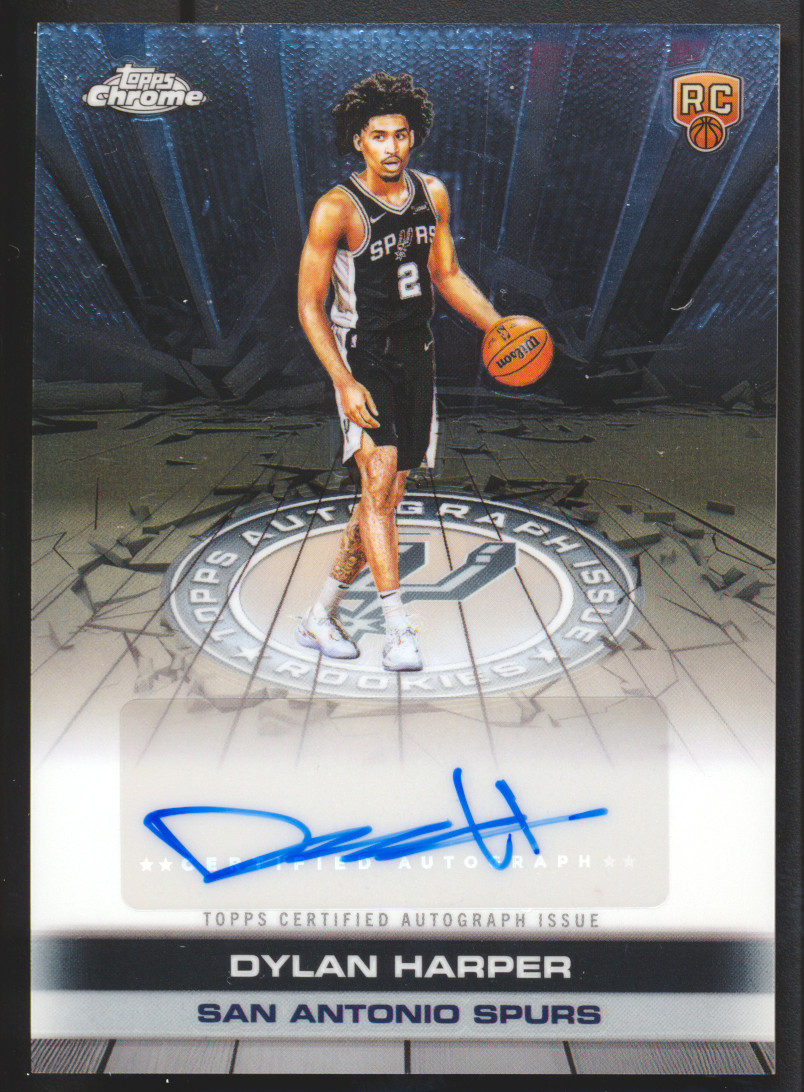
Dylan Harper Topps Chrome raw autograph
- Bought
- $117
- Sold
- $175
- Profit
- $33
Now let's do some quick math. Say you have $200 to work with, and two choices for the next six months:
- Option A: One card that goes up 50% over six months. You make $100.
- Option B: A card that goes up 30% in two months. You sell it, buy another one, and do it again. Three times. You make $239 if you reinvest profits into the next card each time.
Three quick singles beat one slow double.
That's why I care so much about how fast a card sells, sometimes even more than how high it could go.
My Price Range
For most of the past year, the bulk of my buys have landed between $50 and $400.
That range hits a sweet spot. These cards are cheap enough that one miss won't wreck your month, but expensive enough to be worth grading, worth listing, and worth your time. Plenty of buyers shop in this range too, which means they sell.
Lately, I've been moving up into $500 to $800 cards. That's how I scale, and it only made sense once I'd built up a bankroll and a lot of reps.
$50 to $80 is a great place to start, but I'd work my way up to more expensive cards as soon as you build some confidence.
The Card Types I Buy
99% of cards aren't worth buying. Here's what I look for:
- Rookie cards from flagship sets. Think Panini Prizm and Topps Chrome. These are the proven sets that hold value (just make sure that you're getting licensed cards: Topps is the current license holder for the 3 sports).
- Popular parallels. Silver Prizms, refractors, and numbered color versions of those rookie cards. They're rarer than the base version, and collectors love them.
- Rare inserts. Some of my best recent flips were inserts like Rock Stars and Sapphire Selections. A good insert of the right player can outrun his base rookie by a mile.
- Autographs from top brands. An autograph of a player people care about has a built-in group of buyers.
- Base rookies, but only for generational players. A base rookie of superstar talent can be worth it.
And here's what I skip:
- Base cards of regular players
- College and unlicensed cards
- Cheap "filler" cards that only look valuable because of a fancy design (like dime-a-dozen inserts)
- Any card from a new or cheap brand or set
I've learned that there's always another card.
The Player Types I Buy
Players come and go, so instead of telling you exactly who to buy, I'll show you the types of players I look for.
| Player type | How their cards behave | Examples (2026) |
|---|---|---|
| Established superstar | Slow and steady. A real floor, but big jumps are rarer. | Victor Wembanyama, Shai Gilgeous-Alexander, LeBron James |
| Young player on a superstar path | My sweet spot. They move fast, and the upside is huge if they keep it up. | Cooper Flagg, Dylan Harper, Junior Caminero |
| Young and unproven | Fast in both directions. Not as much hype as the type above this, but enough to move the needle. | Fairly high draft picks in their first year or two |
| Solid veteran | Rarely moves much. I'll only take small flyers here. | Austin Reaves, Dak Prescott |
| Retired legend | Long-term holds, which I also call 401(k) cards. No time frame for selling. Just hold and enjoy the ride. | Michael Jordan, Kobe Bryant, Tom Brady |
One thing to keep in mind: being great right now isn't always the same as being collected for decades. Tim Duncan and Kobe Bryant were both all-time greats from the same era.
The same Topps Chrome PSA 10 rookie for Kobe sells for more than 20 times what Tim Duncan's does. Boring big men just don't get the same hobby love.
Stack Your Reasons
None of this matters if you skip the most important step.
Even if a card checks every box in this chapter, I still won't buy it without two or three real reasons the price should go up. The right card type and the right player only get it onto my target list. The reasons are what get me to actually buy.
A few of the reasons I look for:
- The price has dipped, and there's a clear reason it should come back (injuries, poor team record)
- A playoff run is coming up (basketball is the most predictable)
- The player's role is about to grow (like a backup QB getting the starting nod)
- The pop count (how many graded copies exist) is still low
- Nobody's talking about him yet (1st or 2nd year guy flying under the radar)
I also have a few other frameworks I use before buying: my Position Rule, the 11 Situations I watch for, and a full list of landmines that burn most collectors. Those go deeper than I can cover here, but the basics in this chapter will keep you out of most trouble.
Chapter 5 in a nutshell
- Cheap cards are riskier than they look. They're harder to sell, too cheap to grade, and need huge moves to be worth your time.
- Liquidity is speed. Three quick singles beat one slow double.
- Most of my buys land between $50 and $400. I've only recently moved up to $500 to $800 cards.
- Buy flagship rookies, parallels, rare inserts, and autographs. Only buy base rookies of generational players.
- The sweet spot is a young player who already looks like a future superstar.
- No card gets bought without two or three real reasons stacked behind it.
Chapter 6
Timing: Buy Quiet, Sell Loud
I mentioned earlier that I paid $150 for a 1997-98 Topps Finest PSA 9 Tim Duncan.
If you pull up that card's price history on CardLadder, you'll see a long line of sales bouncing around... and then one sale sitting way up at the very top of the chart, higher than anything before or after it.
That's mine. I bought the single highest sale in that card's history because I listened to an influencer on a podcast.
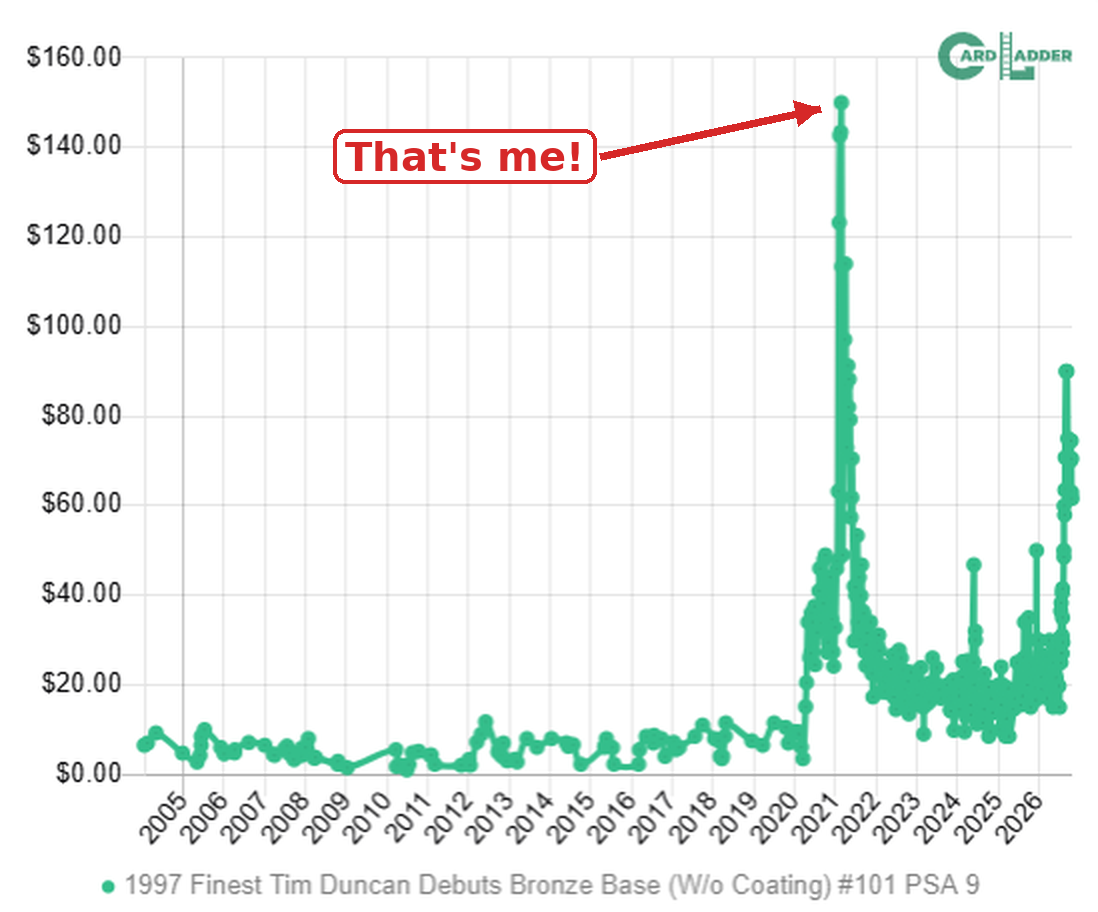
Within a year, the same card was selling for around $15.
I still have it. Every so often I pull up the chart, look at my little dot sitting at the peak, and smile. It has lately moved in my favor, and I like to joke that my plan was a 10-year flip to break even!
My problem was deciding that Tim Duncan was one of the greatest ever and should go up over time...and I bought at current prices.
I had no clue I was buying at all-time highs. I didn't even have CardLadder at the time. I just paid around (okay, slightly more than) the recent comps.
It seems obvious now, but the lesson learned is to make sure you're not buying at all-time highs.
Reading the Chart
The best way to understand price movement is to study charts, and you can study them without having to buy any cards.
Here's how I practice. I pull up a flagship rookie with a lot of sales, like a Prizm or Topps Chrome rookie of a big-name player. Then I look at every spot where the price jumped or dropped, and I ask myself one question: why did it move right there?
Once you're able to explain these bumps on the chart, you start seeing these patterns over and over.
And once you see the patterns, you can spot them before they happen.
For example, here's Luka's PSA 10 Prizm chart:
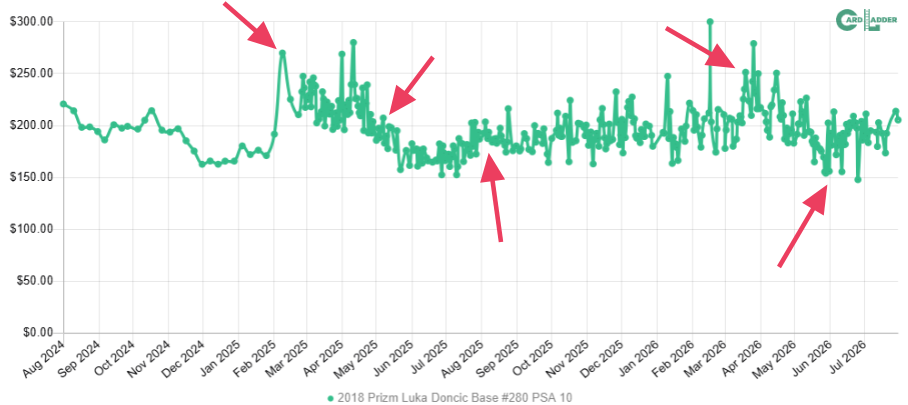
In order from left to right, here's what happened at the arrows:
- Traded to Lakers
- Got bounced from the playoffs
- Men's Health cover about how in shape he was
- Lakers big run near end of season
- Injured and then bounced from playoffs
(Note: if I'm unable to explain why pricing has dropped or increased, I'll usually stay away. I invest in predictability.)
A few rules for using price charts to flip cards:
- Buy after a decrease, with a reason it should turn around. Buy a card that's been sliding for a real (and temporary) reason rather than chase one that already spiked.
- One outlier sale doesn't redraw the line. Every chart has a random sale way above or below the rest. Ignore it. Look at where most of the sales are landing.
- Find the ceiling and the floor. On an established player, prices often bounce between a high and a low over a year or two. Buy near the floor, sell near the ceiling.
- This only works on proven players. A rookie with three months of sales doesn't have enough history to read yet. For them, you'll have to lean more on your future projections rather than price history.
If I'd done any of this before buying that Duncan card, I would have seen I was paying a price nobody had ever paid before. That's a pretty big clue to run the other direction.
Prices Peak Before the Big Moment
Here's a pattern that trips up almost everyone.
You'd think a player's cards would jump right after he wins MVP, makes the All-Star team, or wins a championship. Usually, they don't.
Price generally climbs on the way to the big moment. By the time it actually happens, the price has already baked it in.
Then the excitement fades, and so does the price.
I've watched this happen with championship runs again and again. Prices on the stars climb all through the playoffs, peak somewhere before the title is won, and then slide back down once the parade is over.
I have a dozen screenshotted examples of this on my computer, but I'll just share a few here so you don't fall asleep.
Here's Shai Gilgeous-Alexander after his two MVP announcements. Notice the price drop right after:
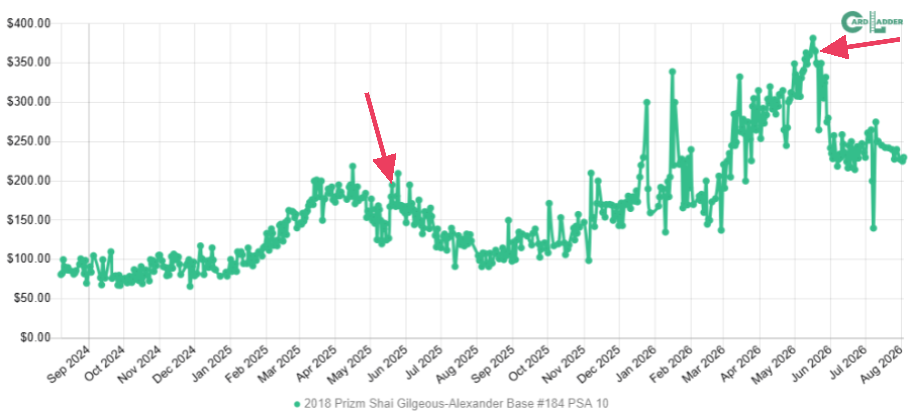
Or, here's Sam Darnold after winning the Super Bowl:
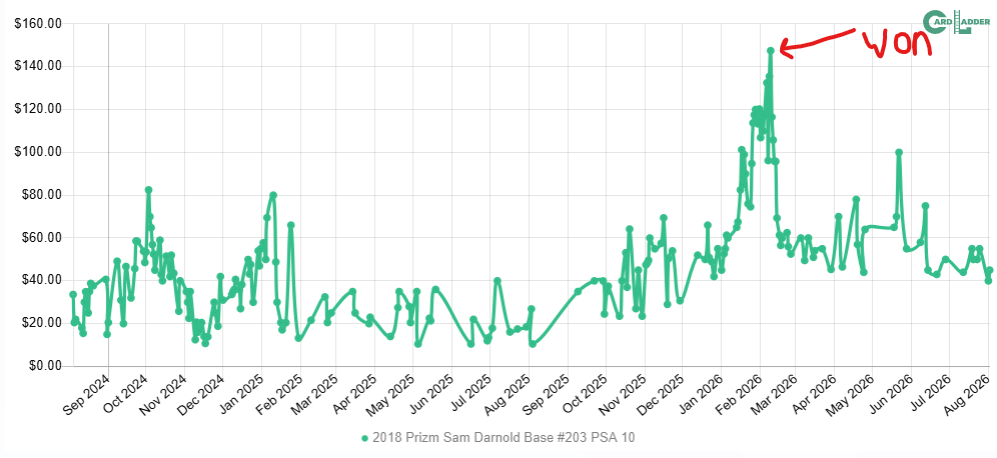
So my rule is simple: sell before the big moment, not after. If I'm holding a card of a player headed for an award or a title, I'm usually listing it while the hype is building.
Most People Buy on the News Before They Think
A player gets traded to a big-market team. Within hours, people are buying his cards like crazy.
Then, a week or two later, things calm down. People realize he's the same player in a different jersey, and the price drifts back down.
This happens all the time with trades, big free agent signings, and viral highlight plays. The hobby reacts first and thinks later. Even minor league callups have price spikes that settle back down.
When big news hits, I try to do the opposite. I wait, watch, and ask whether the news actually changes how good this player is or how much people will want his cards a year from now. Usually, it doesn't. And if it does, the card will still be there next week, probably at a better price.
Wait at Least 3 Months After a Release
When a new card set comes out, prices start high. Everyone wants the shiny new rookies, and there aren't many copies out there yet.
Then people keep opening boxes. More and more copies hit eBay, and prices slide. It happens with every release.
The rule of thumb is to not buy cards from a new set until at least 3 months after it comes out. By then, the early excitement has worn off, the supply has caught up, and I can see what a card is really worth.
Sometimes, you'll need to wait more than 3 months. Wemby Prizm PSA 10s dropped for 9 months after they started hitting the market! That's what happens when flagship rookies for generational prospects come out.
Waiting feels boring, but it's one of the easiest ways to avoid overpaying.
The LaMelo Lesson
Back when I was still pretty new to flipping, I bought a LaMelo Ball Prizm Draft Picks card for $25 right after it was released.
LaMelo was everywhere. He had a huge following, a famous family, and everyone was talking about how good he was going to be. I figured I was getting in early.
Within a few months, that card was worth about a dollar.
I made two obvious mistakes:
- Buying at the peak of his hype right after release. I thought that "he's going to be good" and "people are talking about him" was enough to go buy him. Boy was I wrong.
- Non-pro uniform. On this card, he's wearing a black t-shirt with no logos, so he could've just been playing in an open gym. When licensed pro uni cards come out, everything else tanks in value.
Honestly, it was probably worth that $25 lesson at the time...but I'm hoping that by sharing this, you can avoid making this mistake altogether.
When Timing Goes Right
Now for a happier story.
When Jayson Tatum tore his Achilles, pricing dropped, as you'd expect. Knowing we wouldn't get to see him on the court for a while is a great way for the hobby to lose interest.
During his recovery, I bought a Tatum Rock Stars card for $70.
My reasons were pretty simple:
- Superstar in his prime.
- The injury was serious, but it shouldn't end his career.
- Price was low because people were scared.
- The Celtics should still be a wins machine.
Nothing had actually changed about how good he was.
I sent the card to PSA, and it came back a 10.
When Tatum came back and started looking like Tatum again (or at least close to it), the buzz came right back with him. That's when I sold for $295, netting about $150 after all costs.
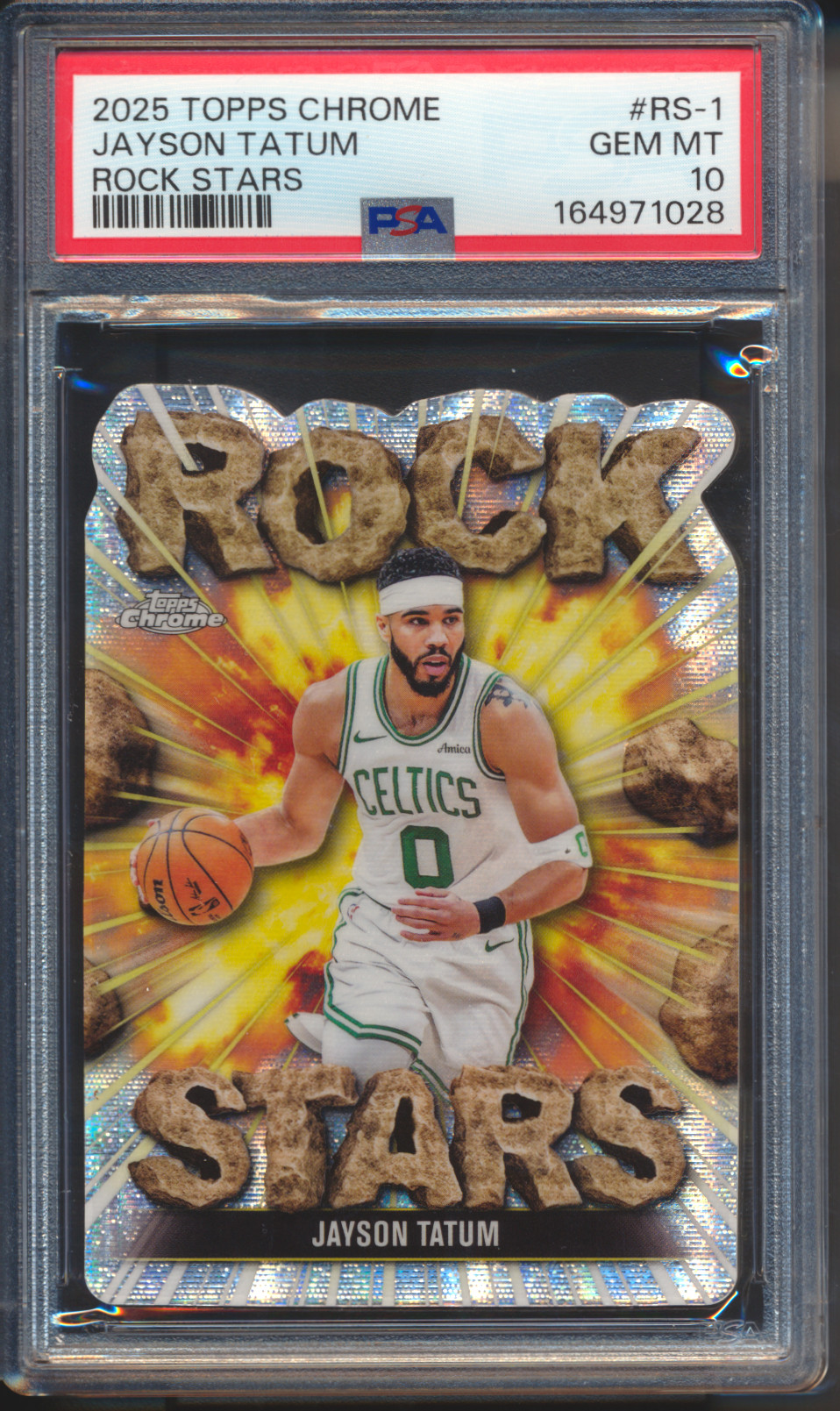
Jayson Tatum Rock Stars PSA 10
- Bought
- $70
- Sold
- $295
- Profit
- $150
Buy when price is low and there are 2-3 reasons prices will come back up (put that on my tombstone).
It sounds drop-dead obvious...
But there's a reason I've already said it like 5 times...
Because most people don't do it!
Chapter 6 in a nutshell
- Buy when a player isn't being talked about, and sell when the hype is back.
- Learn to read a price chart by asking why the price moved at every bump.
- One outlier sale doesn't redraw the line. Look for the ceiling and the floor on proven players.
- Prices usually peak before the big moment (MVP, All-Star, a title). Sell before it happens.
- Most people buy on the news before they think. Wait a week and see if the news really matters.
- Wait at least 3 months after a new set comes out before buying from it.
Chapter 7
Grading: The Value Lever You Control
Most of what moves a card's price is out of your hands. You can't make a player score 40. You can't stop an injury. You can't control when the hobby decides to get excited.
Grading is different. I have much more control over the card increasing in value.
When a raw card comes back from PSA as a 10, it can be worth several times what I paid for it, even if the player didn't do a single thing that week. That's why grading is behind most of my biggest wins.
2 Ways to Win With Grading
When I buy a card for grading purposes, there are two ways for value to increase.
The first is that the card comes back a PSA 10, which usually increases the value significantly.
(By the way, PSA is the only company I use, because I like money. Nobody else can touch the resale value of PSA-graded cards.)
But the second way is how you hit home runs:
The player also increases in value while the card is away at PSA.
That's how some of my big wins happened with Dylan Harper. I bought a few cards during the "dog days" of his rookie season, which happens around February.
People tune out the league a bit because early season hype has worn off and the playoffs are still months away.
I sent those cards to PSA, and they came back 10s! Those cards had also gone up 2 to 3x because of his playoff run.
Case Study: Dylan Harper Sapphire Selections
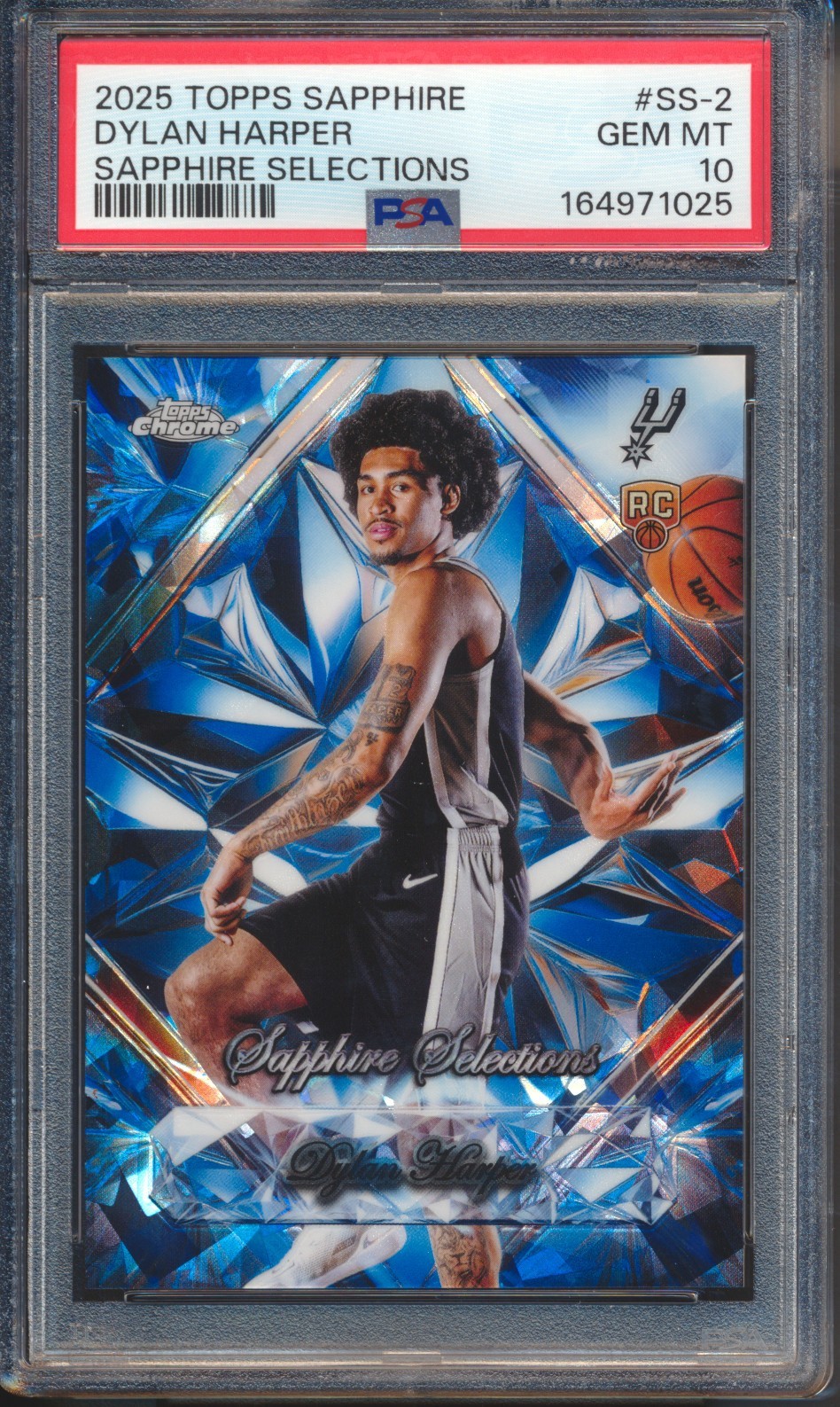
| Bought raw (Feb 24, 2026) | $115.27 |
| PSA grading & shipping | $28.83 |
| Total in | $144.10 |
| Grade | PSA 10 |
| Sold | $684.42 |
| eBay fees & shipping | $102.98 |
| Profit | $437.34 (about a 300% return) |
This card becoming a 10 made this a winning play... but it was the fact that all Harper cards went up significantly due to his playoff run that gave this card a 300% return.
Of course, the key to all this is being relatively certain the card you're sending in will receive a 10 grade. This is the scary part, and what keeps many people away from grading.
But I've historically had a hit rate on PSA 10s of about 85% to 90%. I'm thorough with my inspection process, so I generally do better than the average grader.
Grading becomes a lot less scary when it works out big in your favor most of the time.
Know It's a 10 Before It Goes In
I only send cards I'm already pretty sure are 10s.
Every grader looks at the same four things:
- Corners: sharp, with no rounding, dings, or white showing
- Edges: clean, with no chipping or rough spots
- Centering: the picture sits evenly inside the borders (for a PSA 10, about 55/45 or better on the front, and more forgiving on the back)
- Surface: no scratches, print lines, dents, or fingerprints
My rules for assessing condition are pretty simple:
If I see one significant issue, or two minor ones, I won't send the card in.
If I see one very small issue, I'll send the card in. Usually it's an issue that's so small that I'm not 100% sure if it is an issue or not.
If it's somewhere in between... well, that's where your experience comes into play, and I'd recommend reading PSA's grading guidelines. I usually lean towards not sending unless I'm pretty sure.
I don't use anything too fancy when assessing condition:
- A jeweler's loupe for checking corners and edges up close
- A centering tool so I'm measuring instead of eyeballing
- A bright light I can tilt the card under to catch surface scratches
- A microfiber cloth to gently wipe off fingerprints and dust before I seal it up (you'd be amazed how many "surface flaws" are just smudges)
Some cards are much harder to get a 10 on, and I'm extra careful with them:
- Thick cards, like relic cards, have more surface area on the edges to watch for
- Black or dark borders show every tiny chip and scratch
- Chrome cards often have little dents or places where the Chrome finish is wearing off (often on the edges)
If I'm buying raw cards online, this is where the Monday hour photo requests come in. I ask the seller for clear shots of the front, back, and corners before I buy. If the photos aren't good enough to judge, I pass.
Check the Gem Rate
Even a card that looks perfect to me can come back a 9. So before I grade, I check one more thing: the gem rate.
The gem rate is the share of graded copies of a card that came back a 10. I look it up on GemRate.com, and it takes about thirty seconds.
My rule of thumb:
- Below 60%: I usually skip it. The odds are working against me, even on a card that looks great.
- 65%: That's usually my minimum.
- 70 to 75% or higher: If you're risk averse, or if it's a lower profit card, stick to cards with better gem rates.
Checking the gem rate singlehandedly improved my profitability more than almost anything else.
I will say that I've seen successful graders send in cards that have very low gem rates (like sub-40%) because there's so much profit to be had. The math technically works in their favor.
I don't like it. I don't like knowing that more than 60% of the time, I have a losing investment.
The Math
Every card you buy has 3 potential outcomes:
- Card arrives at your house and you determine it's not gradable
- PSA gives it a 9 (or worse, but that's rare)
- PSA gives it a 10
Now, each of those outcomes has a percentage likelihood of that happening, with a different financial return.
The math gets a bit annoying, so my good friend Claude and I built a calculator. I usually only give it out to people on my premium newsletter, but since you're this far into the case study, it's clear you're someone who's pretty darn ready to flip cards.
Here's the link:
Should I Grade This Calculator
You'll just fill in the inputs and it'll spit out the average return on buying that card for grading purposes.
(Don't forget to adjust the PSA grading costs for the tier you plan to use.)
I use this literally every time I'm looking to buy a card to grade.
"The grading module was the most helpful for me because I didn't understand the math behind the process. I had previously sent in some cards to grade and was disappointed when they didn't come back 9s and 10s. Cameron's instruction made me much more confident in knowing when to grade and when not to."
Rob H.
When It Works
I'd sent in a few cards here and there when I was new to investing, but I didn't know what I was doing.
They were random cards that looked good to the naked eye, and I used an assortment of companies (like SGC and HGA).
But after tightening up my strategies and doing the correct math, I started making consistent money.
I still remember my first real grading win. It was a small order of just three cards. When the grades came back, all three were PSA 10s, and together I profited about $600.
My first thought was, "Wait, that wasn't that hard. It actually worked."
Now, I want to share with you a cheaper flip I sent in to show you this can be done on a smaller scale.
Case Study: Jeremiah Fears Sapphire Selections
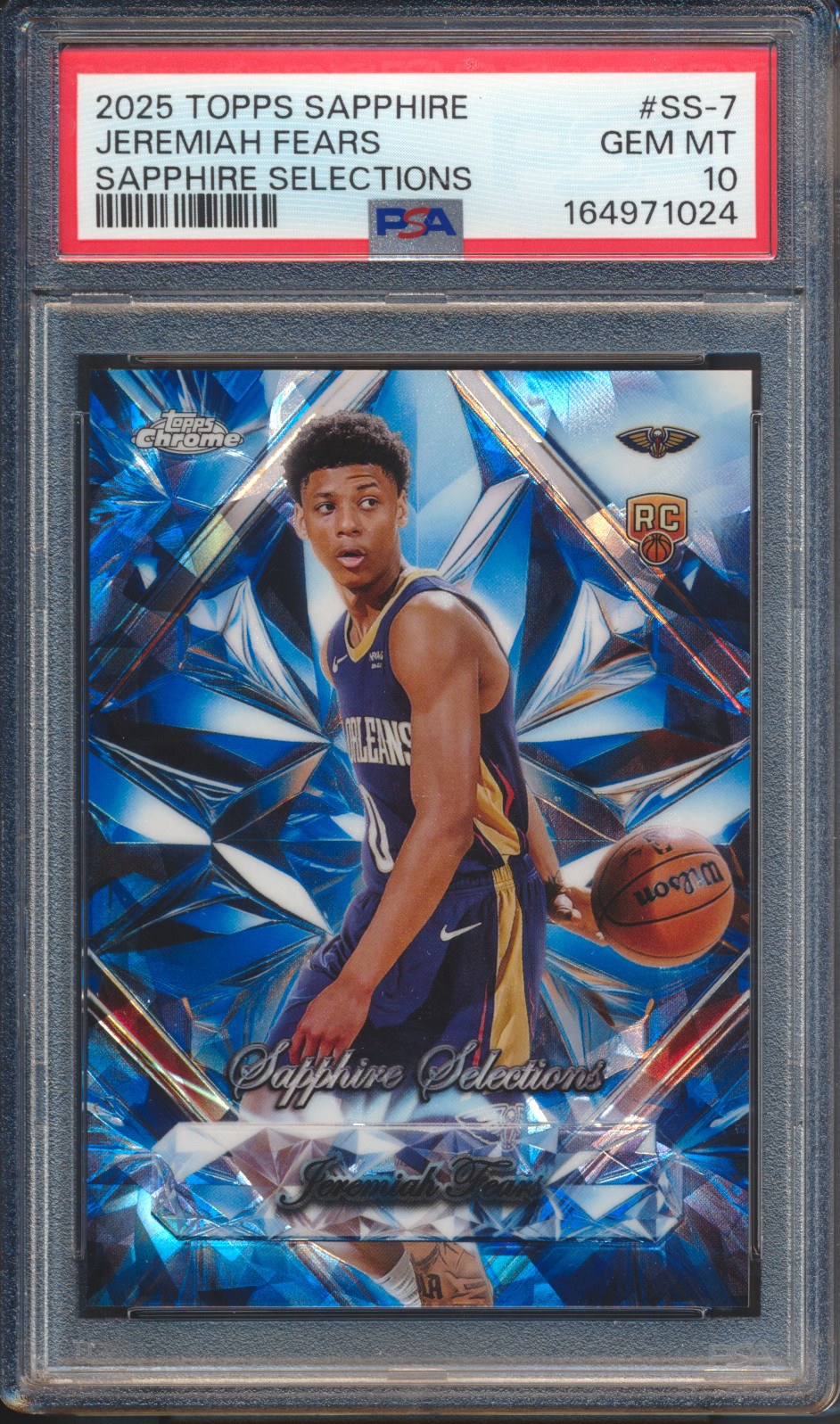
| Bought raw (Mar 14, 2026) | $42.57 |
| PSA grading & shipping | $28.83 |
| Total in | $71.40 |
| Grade | PSA 10 |
| Sold | $210.00 |
| eBay fees & shipping | $30.90 |
| Profit | $107.70 (about a 150% return) |
I spent around $70 and I more than doubled my money! Wins like this can really add up fast on orders of 5 to 10 cards (when PSA has their $25 tier open, anyway!).
When It Doesn't
Now the other side.
I bought an Abdul Carter Downtown card for $295, sure it was a 10. It came back a PSA 9, despite a high gem rate.
That one grade turned into a loss of close to $100. My options were to hold it through the offseason and hope the excitement of the new season drove prices back up, or to sell it and move on.
This wasn't a card I wanted to hold for 4-5 more months, so I took the loss and bought basketball cards to grade.
It's always a hit to my ego to lose $100, but it didn't sink me because I know my overall hit rate is high on PSA 10s.
Grading Tiers
PSA has several tiers, with associated turnaround times.
For example, right now the lowest tier is $40, with a turnaround time of around 4 months. The max value on a card in this tier is $500 (essentially, what you expect the card to be worth after grading).
Prices go up from there, and turnaround times improve. Check PSA's pricing page to see what's currently available.
The easiest rule of thumb is to pick the cheapest tier where PSA 10s of the cards you're sending can fit under the max value.
Chapter 7 in a nutshell
- Grading is a value lever you control, and it gives your cards a way to win without being dependent on their play or seasonality.
- Check corners, edges, centering, and surface with the right tools.
- Check the gem rate first. 60 to 65% is my minimum, and 70 to 75%+ is ideal.
- Run the numbers using the "Should I Grade This Calculator" on every card.
- PSA is the only company that I use.
- Judge grading by the whole batch. A 9 here and there is part of the math.
- Grading prices and wait times change often, so check them before you submit. You'll commonly wait 2 to 4 months.
Chapter 8
Selling With Little Effort
Next, let's talk about how you actually walk away with profit... while having it fit inside your 5-hour flip week.
As you can guess, I'm not a fan of going live on Whatnot and then delivering 50-100 different packages to various addresses. I'd rather stab myself in the eye with a sharp stick.
Monitoring my eBay store and constantly adjusting prices and listings isn't my idea of a vacation, either.
Over time, I've figured out a few strategies that lead to:
- Selling cards in 1-2 days (if it's time for them to sell)
- Selling my pure flips without monitoring anything (literally just get an alert when it sells)
- Still selling for a profit
Decide the Exit Before You Buy
One of the surest ways to avoid overly managing my listings is to:
Decide what price I'll sell a card before I buy it.
On cards I'm not planning to grade, I relist them immediately when I get the card.
For example, a while back, I bought a Red Ice Prizm Jalen Williams PSA 10 rookie for $50.
When I got the card, I immediately relisted it for $95. I targeted that sale price even before I paid the $50.
Of course, that was much too high at the time, but here's why I do this with my pure flips:
- I don't have to constantly check the card's price and quickly list when it spikes. I already have it up and ready.
- I often get sales on cards I haven't thought about in a while (which is essential to keeping a 5-hour flip week).
- I use eBay as my digital inventory with pictures and the price I'm looking for. Rather than flipping through my boxes to find what else should I sell, it's all digitized. You could use some software or a spreadsheet for this... but why not eBay?
Then about 4 months after I bought it, I woke up one day to see that it had sold. Now, I know that 4 months to profit around $20 (after fees) isn't making you rich... but it was a "flyer" pickup that required very little work from me.
Selling this way keeps me from one of the biggest rookie mistakes:
Holding cards for too long. Trying to time peaks is a great way to lose money because they're nearly impossible to predict.
Taking wins at preset prices is a fantastic way to consistently profit with very little work. I could share a dozen other examples of cards that I hadn't thought about in months selling all of a sudden.
My Targets
How do I pick the exit price? I work backward from a target return:
- About 30% after fees on cards in the $50 to $400 range
- 10 to 20% on pricier cards, since the dollar amounts are bigger
- 40%+ on smaller cards
Those are realistic numbers that don't require massive runners to hit your target. Setting pie-in-the-sky goals often results in you holding out for unrealistic peaks... and that's how you get a stack of unsold cards.
Here's an example of a smaller card that was a quick win:
Austin Reaves Silver Prizm PSA 9 rookie
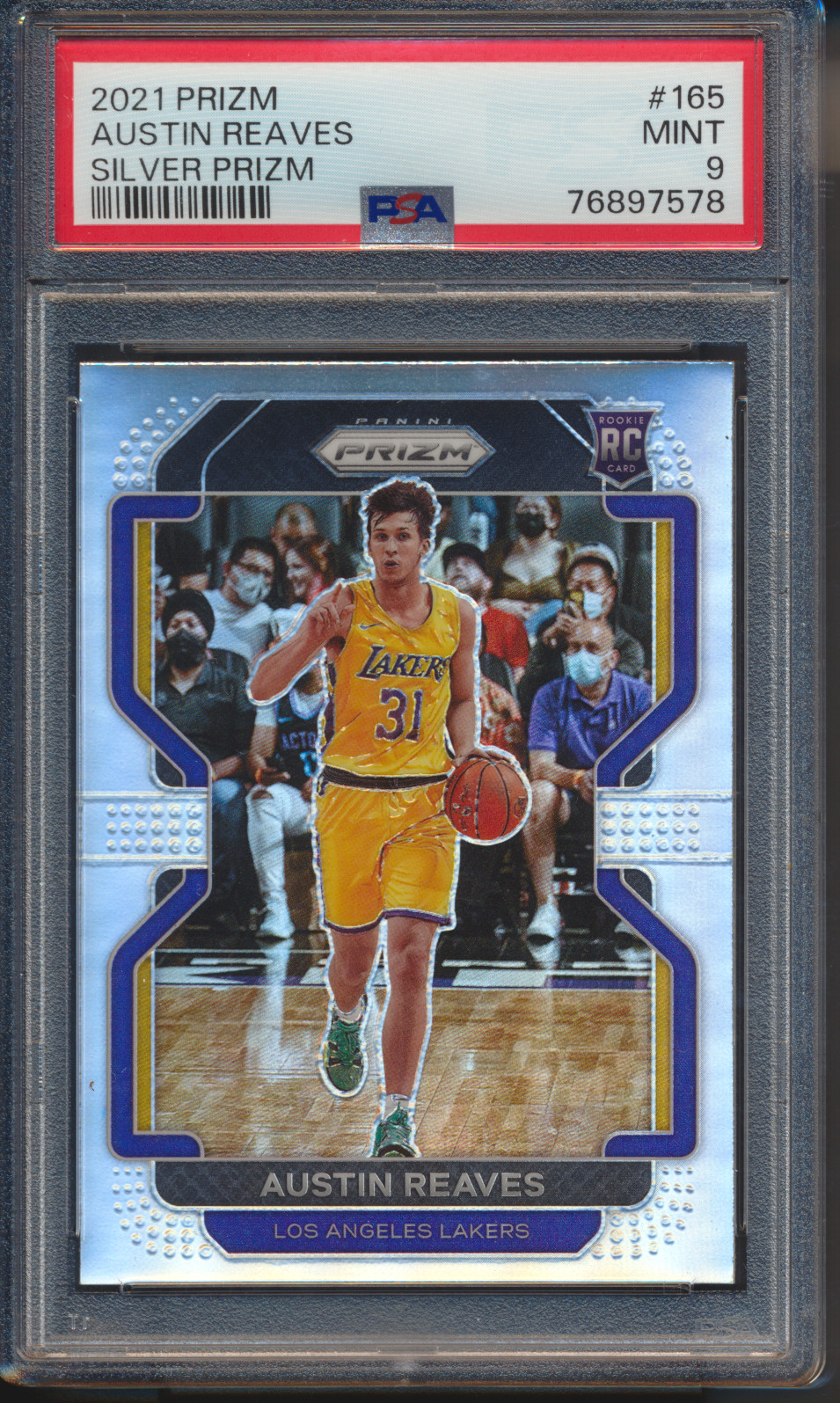
| Bought | $45.51 |
| Sold (32 days later) | $80.45 |
| eBay fees | $11.06 |
| Shipping | $5.45 |
| Profit | $18.43 (about 40%) |
Look how much those fees and shipping ate. The card sold for $35 more than I paid, but I only kept about half of that. But 40% on a card I moved in less than a month is a win.
I pick 30% for most of my cards because it's a realistic target over 3-6 months. If you put the target much higher, you're often waiting for a price that never comes.
A Quick Primer on Fees
When you're buying & selling, remember that it's not as clear as "buy an eBay listing at $100, and resell for $130" to get a 30% profit.
When you buy a card, you'll pay taxes & shipping.
When you sell a card, eBay takes around 13%.
So that $100 card ends up needing to be resold for around $167 in order to profit 30% after fees.
First Profit Is Best Profit
I learned my favorite selling rule from a CEO I used to work with who owned a business flipping houses. He'd personally done more than 500 deals on much, much larger assets than I work with.
He told me about a house early in his career where his break-even price was $450,000. His goal was $500,000. Early on, an offer came in for $485,000.
He turned it down. It wasn't $500,000, and he figured a better offer was coming.
It never did. The house sat, the market shifted, and he eventually sold it for $466,000. Waiting for a peak price cost him about $19,000 and months of time.
The lesson, and the phrase he said all the time, was:
First profit is best profit.
When a good offer shows up, especially early, take it seriously. That $485,000 offer was pretty good profit, and it would've allowed him to wash his hands of the deal and move to the next one.
This happens constantly with cards. You have an offer that represents good profit, but you think "maybe it'll keep going," and you hold. Then the hype cools, the price slides back, and you end up selling for less than that first offer. Or, you're too proud or attached to let a card go for a loss, so the cards stack up on your desk.
When a card hits my number, I sell it. I don't try to squeeze out the last dollar. Someone else can try for that.
Plus, it requires much less work to accept the first good offer and move on. I don't have the mental bandwidth to continue to manage a bunch of cards I'm frequently getting offers on.
Pricing Cards Fresh From PSA
When a card comes back from PSA as a 10, I typically want it sold fast. So I don't list it at the highest recent sale and hope.
Instead, I look at recent sold prices and I'll list with offers allowed, with a target to sell around 5% under the going rate.
Say recent PSA 10 sales are around $420. I'll list at $420 but accept an offer around $400.
Why leave money on the table? Because a card that sells this week is worth more to me than a card that might sell for $20 more in a month. That $400 can go straight into my next card.
There's one exception. If a card is very liquid (it sells all the time) and the comps are rock solid, I'll sometimes hold out for more. Typically, I'll think about it like a card I bought for a pure flip: can I stack 2-3 reasons this card will go up in the near future?
Here's an example of a card I've got now. I graded a Cooper Flagg Topps Cosmic Chrome Planetary Pursuit Sun (That's a mouthful!).
It just came back a 10, and I got an offer on it right away.
It's an exception to the "first profit is best profit" rule because I think this card could significantly rise in the coming months.
At the time I'm writing this, he's just starting his second season. Here's why I think he'll rise:
- His team is winning.
- He's looking like a superstar, similar to LeBron and Luka in their second seasons.
- It's a desirable and liquid rookie insert graded as a 10.
- His floor is high. It's unlikely this card turns into a loss of any real size.
- He's outrageously young. If it turns out his card values don't increase, it's a pretty good backup plan to just keep holding him.
How to Evaluate a Card That's Moved Against You
When I have a card where prices have dropped, I'll ask myself:
"Hey Cameron, if I didn't own this card, would I buy it today, at today's price?"
- If yes, I keep holding.
- If no, I sell it and move the money into a card I actually believe in.
Notice that there's nothing in there about what I originally paid for the card!
What you paid doesn't matter. The market doesn't know or care what you paid. Holding a card just to "get back to even" is how a small loss turns into a big one, or how your money gets stuck for months.
Here's a real example:
I bought a TreVeyon Henderson Micro Mosaic for $145. It never took off the way I expected. A few months later, I couldn't come up with good reasons to keep holding. So I sold it.
After all costs, I lost about $35.
But it freed up $110 for my next card, instead of sitting on a card when all logic said it wasn't going to turn around anytime soon. This thinking keeps my losses smaller.
Why Fast Singles Win
Put all of this together, and you get a lot of quick wins. My Topps Chrome Harper autograph sold in 18 days. The Reaves PSA 9 sold in 32. My Wemby in the playoffs sold in 2 weeks. Even the Henderson loss was over and done in a few months.
Plus, when you're able to move faster, you get more reps.
I spent two years in Mexico, and my favorite food there (and it's not close) is the tacos al pastor you get at outdoor carts. When I came home and got married, I got obsessed with making the perfect recipe. I've made it twice a month for 15 years, and most of the time I change something (the pineapple, how I char the meat, the marinade) to see if it gets better or worse. It's so good now. My wife, who never gets excited about food, says it's the best thing I make.
Flipping works the same way. You learn something from every card you buy and sell. If one card takes 8 months to sell, you learn one lesson in 8 months. If you're doing quick singles, you might learn 8 lessons in that same stretch.
Fast sales grow your bankroll, and they make you a better flipper, faster.
Chapter 8 in a nutshell
- Decide your sell price before you buy, and list the card as soon as you have it.
- Aim for about 30% after fees on $80 to $400 cards, 10 to 20% on pricier ones, and 40%+ on smaller cards.
- First profit is best profit. When a card hits your number, or close enough, sell it.
- The exception: hold longer only if the card is liquid, the comps are solid, and you can stack 2-3 reasons it will rise.
- Fresh from PSA, list with offers on and aim to sell about 5% under recent sales so it moves fast.
- If a card goes the wrong way, ask whether you'd buy it today. What you paid doesn't matter.
- Fast singles grow your money and give you more reps.
Chapter 9
The Scoreboard: What a Typical PSA Order Looks Like
I've thrown a lot of numbers at you, including several examples of successful flips.
However, I want to put it together and show you one real PSA order that I sent in.
It's not my best PSA order ever, but it's a really good snapshot of what they often look like.
What I Sent In
I sent this order in early 2026. I bought all five cards raw between mid-February and mid-March, during the "dog days" of the basketball season, and sent them to PSA together. All are from 2025-26 except the Burrow.
| Card | Total in (card + grading) | Grade | Sold for | eBay fees and shipping | Profit |
|---|---|---|---|---|---|
| Dylan Harper Sapphire Selections | $144.10 | PSA 10 | $684.42 | $102.98 | $437.34 |
| Jayson Tatum Rock Stars | $98.44 | PSA 10 | $295.45 | $46.98 | $150.03 |
| Jeremiah Fears Sapphire Selections | $71.40 | PSA 10 | $210.00 | $30.90 | $107.70 |
| Austin Reaves Paradox | $68.24 | PSA 10 | $131.82 | $21.08 | $42.50 |
| 2020 Joe Burrow Prizm | $49.09 | PSA 9 | Still have it | N/A | About -$20 |
| Totals | $431.27 | $1,321.69 | $201.94 | About $715 |
So here's the scoreboard:
- Money spent: $431.27
- Money back after fees: $1,119.75, with the Burrow still left to sell
- Profit: $688.48 already in my pocket, and about $715 once the Burrow sells. That's roughly a 160% return on the whole order.
The entire thing, beginning to end, definitely took less than 10 hours of active time (maybe even 5, but it's hard to pinpoint time input over several months).
This was sent in at the $25 level, and I got it back in 3 months.
Why It Worked (and Why One Card Didn't)
This order wasn't luck... and in fact, it's pretty typical. Here's my thought process about the results:
The big three (Harper, Tatum, and Fears). These were the cards I was most confident in. I checked corners, edges, centering, and surface on every one. All three had strong gem rates. And I bought them during a quiet stretch, when prices were down and nobody was paying much attention. They came back 10s, and two of them had also gone up in value while they were at PSA. That's the "two ways to win" from Chapter 7 in action.
The small win (Reaves). This one came back a 10 too, but only profited $42.50. That's still a solid single, but I'd originally hoped for $70+. The Paradox cards dropped across the board while the card was at PSA.
The miss (Burrow). This one's on me. It was a cheap card I tossed in on a whim, and its gem rate wasn't great.
But here's what's important:
The miss cost me about $20. The big three made almost $700. That's batch math in action.
When your hits are bigger than your misses, one bad card can't hurt you much.
What a Normal Month Looks Like
So how does an order like this turn into a monthly income?
In a normal month, about one PSA order comes back, and a few of my pure flips sell. Some orders are smaller than this one. Others have a home run (or two) in them, like that Ace Bailey that made about $790 by itself.
I'll be honest about one downside of the way I flip cards:
The money comes in lumps. I average $1K to $2K, but I have plenty of months over and under that.
If I were flipping 50 cards per month, it'd be easier to smooth out my income over time.
However, smaller volume and PSA's ever-changing turnaround times mean ups and downs.
What this means is that some months I'll get back 2-3 PSA orders, and other months I'll get none.
And on the non-graded cards, the market ebbs and flows. When basketball training camp started, I sold 8 cards in a 10-day period. That resulted in a ton of cash flow all at once, but it also brought my inventory down to near zero, and I focused on buying for a while.
And as you probably know by now, I wouldn't change my process for anything.
Track Every Card
I could only show you this order because I track every single card.
If you don't track, you don't really know what cards are working and what's not. You might think you're doing pretty well, only to find out you're breaking even for the year.
My tracker is a simple spreadsheet. (If you join HCL Investor, you get a copy of the exact one I use.) But even a notebook works. Just write it all down.
Chapter 9 in a nutshell
- One real PSA order: $431 in, about $715 in profit.
- Three big wins, one small win, and one miss. The wins were bigger than the miss, so the batch made money.
- The miss was a card I threw in on a whim. The lesson is that every card needs to pass the same checks, even cheap ones.
- I average $1K to $2K a month, but the money comes in lumps when PSA orders return.
- Track every card, including fees and shipping.
Chapter 10
Starting in a Realistic Way
Everything in this case study is the culmination of 5 years of painful mistakes followed by carefully building frameworks and processes that stack consistent wins.
But I wanted to give you a realistic way to start, especially if you've never flipped before.
For the purposes of this exercise, I'm going to assume that you have a $500 budget to get started with.
Strategy
To start, we're going to do the following:
- Buy cards for short-term flips. Blowing your $500 on a long-term hold means your money is tied up for a while. Short-term flips (3-6 months) get your money moving faster.
- Spend half on pure flips. I'd buy 5-10 cards in the $25 to $50 range for pure flips.
- Spend the other half on grading. I'd grade around 3 cards worth about $50 each. Refer back to Chapter 7 about grading profitably.
- Pick your best sport. You can branch out later, but stick to what you know best for now.
Back in Chapter 5, I told you cheap cards are riskier, but I'd make an exception when you're brand new. Cards in the $25 to $50 range keep your mistakes small while you learn to read charts and spot good buys. Once you've got some reps, move up.
(For a smaller budget option, the same strategy works for cards as low as $5 to $10.)
Tools/Resources
You're going to need a few things handy:
- CardLadder ($20/month, 10% off with code HCL), or use 130point.com and track prices over time yourself
- GemRate.com (free) to check how often a card comes back a PSA 10 before you send it in (Chapter 7)
- eBay account. It's fine if you've never sold before. Your first few purchases should give you some feedback, so you're not at zero when you try to sell.
- Various packing/shipping/card protection materials. Here's a separate article I wrote on that so we don't jumble things here.
Your Version of the Monday Hour
I've shared quite a bit about the one hour a week that's the engine of my business.
At first, it'll certainly take you more than an hour. Or maybe you do the hour every day for the first few weeks. It's okay. The time it takes will drop... even if it kind of sucks at first.
But it pays off in the end. I'm proof of that.
So, your Monday hour might go something like this:
- Make a list of 10-15 players that you believe are primed to go up in value over the next 3-6 months (refer to Chapter 5).
- Pick cards for each of those players that are liquid, desirable, and have been proven to hold their value.
- Look at their price history to ensure that you're buying at lows. There should be evidence of past highs, so that if the card hit them again, there would be enough profit for a good flip.
- Search on eBay for your targets and place bids and offers.
- Save your searches so that throughout the week you'll get notified of new cards hitting the parameters.
Done right, you'll be able to win some auctions throughout the week, or have some of your offers accepted!
One thing I love about this is how low-risk it is to get a tremendous education.
If you're buying the right cards at the right time at the right prices, it's less likely any of those cards will crash in value.
And you'll have some winners in there, too.
Even if it goes badly, your $500 might turn into $350... which means you spent $150 to get an incredible boots-on-the-ground education.
The people who quit do it after their initial spend doesn't turn into a life-altering fortune.
Losing money doesn't mean it doesn't work; it just means you haven't figured out how to make it work yet.
Don't quit after the first month or two. Learn, recalibrate, and keep marching on.
And if you want more help doing all this, that's what I'm sharing next.
Chapter 10 in a nutshell
- Start with a $500 budget and short-term flips (3 to 6 months).
- Spend half on pure flips (5 to 10 cards in the $25 to $50 range) and half on grading (3 cards at about $50 each).
- Pick one sport, the one you know best.
- You only need CardLadder (or 130point.com), GemRate.com, an eBay account, and basic shipping supplies.
- Your Monday hour: make a player list, pick liquid cards, check price history to buy at lows, and save your searches.
- Even if it goes badly, your $500 might turn into $350. That's $150 for a real education, so don't quit after the first month or two.
Summarizing the Entire System
Here's the "long story short" version:
The setup
- One platform: eBay.
- 1-3 sports you already watch.
- A small tool stack: CardLadder (or 130point), GemRate, and eBay saved searches.
The week
- One Monday hour: pick 10-15 player targets, research prices and gem rates, set saved searches on your top few, then place bids and offers.
- Everything else happens in 5 minutes or less, in the gaps of your day.
- When the itch hits, put the card on next Monday's list.
Buying
- Stack 2-3 real reasons the price should rise before every buy.
- Buy when it's quiet and the price is down. Skip all-time highs and big news.
- Wait at least 3 months after a new release.
- Stick to flagship rookies, popular parallels, rare inserts, and autographs.
- Most of my buys land between $50 and $400. Start cheaper while you learn, then move up.
- Decide your sell price before you buy.
Grading
- Only send cards you're pretty sure are 10s. Check corners, edges, centering, and surface.
- Check the gem rate. 65% is my usual minimum.
- Run every card through the Should I Grade This Calculator.
- PSA only.
Selling
- List pure flips right away at your exit price.
- Aim for about 30% after fees on $50 to $400 cards.
- First profit is best profit. When a good offer comes in, take it.
- Fresh from PSA, aim to sell about 5% under recent sales.
- If a card drops, ask whether you'd buy it today at today's price. What you paid doesn't matter.
- Track every card.
How We Can Keep Working Together
"Cameron is an excellent resource to help a sports card collector build a strategy for collecting, investing, and selling. I have been following Cameron's newsletter for years, so can attest to his depth, insights, and knowledge. Whether you're just getting started or a veteran of the trade, his strategies are for you."
Bob D.
There are a few ways that I can continue to help you, if this case study sounds like how you want to build a business:
- Free newsletter: Every Thursday, I give out flipping strategies. If this case study was forwarded to you, join the newsletter here. This is a great starting point.
- Paid newsletter: On Saturdays, I go deeper, give more data, and give you the exact cards I'm buying and the price I'd pay. I also record 5-7 minute videos where I walk through why I'm making certain buy/sell decisions that week. Upgrade to HCL Investor here ($199/yr) and get a whole slew of bonuses.
- Casual Flipper Bootcamp: About every 3 months, I run a live training program. It's where I empty my notebook about everything I know about flipping cards (and still have it fit in 5 hours per week). You'll get homework assignments, direct access to me, and resources you can refer to for life. It's built for people who want a guided path instead of figuring it out alone. Since I don't know when you're reading this, the link might be either for the wait list or to actually grab a seat. Check it out here.
Enjoyed this case study?
Share it with a friend! You can grab this link or download it and send it to them that way.
Get in touch with me anytime.
Reply to any email I send out, or fire off a message to [email protected]. I read everything, and I try to get back within a day or two.
Okay. That's everything.
And remember:
If you're following the crowd, you're probably doing it wrong.
Cameron